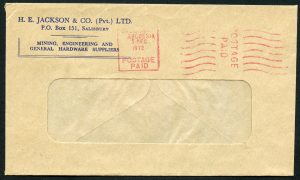
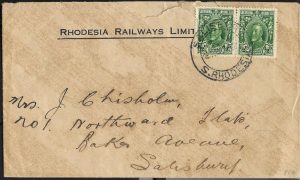
Zambia Airways

Zambia Airways

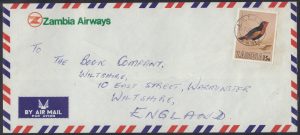
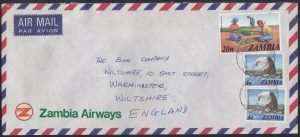
Zambia Airways was founded in 1964 as a subsidiary of Central African Airways. The original fleet consisted of two Douglas DC-3 and three DHC-2 Beaver.
By 1967 Zambia Airways had become independent of Central African Airways and acquired a pair of BAC 1-11-207s and a couple of HS.748s. They also leased from Alitalia a DC-8 with which services from Lusaka to London were started. Originally the London route was flown twice a week with intermediate stops at Nairobi, Kenya, and Rome, Italy. In 1975 the Boeing 707 replaced the DC-8 and the Boeing 737-200 replaced the BAC 1-11s and was often put into service to Johannesburg and other medium-haul routes.

The widebody era arrived in 1984 with the acquisition of a DC-10. This was the only widebody used by Zambia Airways and was used to open a route to New York via Monrovia. This first DC-10, christened “Nkwazi”, was reportedly a point of national pride for many Zambian citizens.

In 1989, a second DC-10 was leased from Sabena and later Lufthansa to help operate longhaul flights from Lusaka to London, Frankfurt, Rome, and Amsterdam, as well as a weekly service non-stop to Bombay in cooperation with Air India. The author James Ferguson, in his book about Zambian society, also recalls services to Belgrade and Larnaca.

Meanwhile, the ATR 42 replaced the HS.748s. The next fleet expansion consisted of a Boeing 757-200F which substituted one of the 707s. Zambia Airways ordered the MD-11 and leased DC-8-61 while waiting for the delivery of the MD-11, which never occurred.

In 1992, the government reportedly indicated that the airline would be responsible for its own debt services and had to meet operating expenses from its own revenues. Under this directive and in a worsening economic climate, the airline very quickly scaled back both domestically and internationally, and was liquidated in 1995.

Events

Postcards

Revenue

Contributors

  • James Gavin

FB

The Salvation Army

The Salvation Army

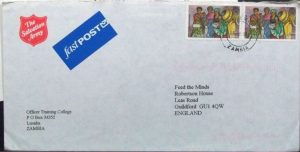
The Salvation Army is a Protestant Christian movement and an international charitable organisation structured in a quasi-military fashion. The organisation reports a worldwide membership of over 1.5 million, consisting of soldiers, officers and adherents known as Salvationists.

The Army was founded in 1865 in London by one-time Methodist circuit-preacher William Booth and his wife Catherine as the East London Christian Mission. In 1878 Booth reorganised the mission, becoming its first General and introducing the military structure which has been retained to the present day. They sought to bring salvation to the poor, destitute and hungry by meeting both their “physical and spiritual needs”.

The theology of the Salvation Army is derived from that of Methodism although it is distinctive in institution and practice. The Army’s doctrine is typical of evangelical Protestant denomination. The Army’s purposes are “the advancement of the Christian religion … of education, the relief of poverty, and other charitable objects beneficial to society or the community of mankind as a whole”.

The Salvation Army entered Southern Rhodesia from its base in South Africa in 1891.  A pioneer party of six families, led by Major Pascoe, set out from Kimberley in May 1891 in a wagon drawn by 18 oxen.  They arrived 6 months later at Fort Salisbury (later Salisbury, now Harare) on November 18, 1891.  Cecil Rhodes had provided the Salvation Army a farm in the Mazoe Valley and it was here that, by May, 1892, missionary work had started.

The early pioneer missionaries struggled with malaria, gaining trust from people, language barriers, cultural differences, uprisings and raids.  Two of the party had left by 1894.  Their missionary efforts were further impacted by the Mashonaland rebellion in 1896.  Work was not resumed until 1901. Initially the missionary focus was preaching and caring for white settlers.  It wasn’t until after a visit in 1908 from William Booth, the head of the Salvation Army, that evangelism efforts shifted towards the “natives.”

For the first 40 years, Salvationists in Southern Rhodesia were under the administrative control of the Commander in South Africa.  That changed in May 1931 when Rhodesia became its own territory with its Territorial Headquarters located in Salisbury (Harare).  The territory initially consisted of Southern and Northern Rhodesia (Zambia) as well as Bechuanaland (Botswana).  The territory has gone through various changes since then.  It was renamed the Zimbabwe Territory in 1988.

The Salvation Army is present in 127 countries, running charity shops, operating shelters for the homeless and disaster relief and humanitarian aid to developing countries.

Missions

References

  • Missions in Southern Rhodesia – Paul King
  • Christian Warfare in Rhodesia-Zimbabwe: The Salvation Army and African Liberation, 1891-1991 – Norman H. Murdoch
  • www.salvationarmy.org
  • www.sawiki.net
Contributors
  • Mark Loomis

Nyadiri Girls School

Nyadiri Girls School

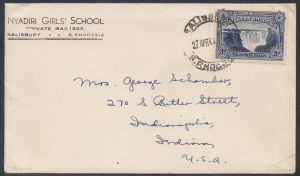
While Dr. Samuel Gurney was constructing a hospital, he also built a residence for missionaries from the Methodists Women’s Foreign Missionary Society (WFMS).  In March 1924, three women were appointed to Nyadiri “to open the Women’s work” (teaching, healing and evangelizing girls and women) – Misses F. Quinton, G. Clark and B. Ramsey.

The first year was a trying one.  Dr. Gurney died just few months after they arrived and they were left on their own. The rainy season the following November was an especially severe one preventing people from getting in or out of the mission.

Notwithstanding the challenges, with temporary buildings for the girls to live, they soon opened a girls’ school. By 1925 there were 72 girls in residence.

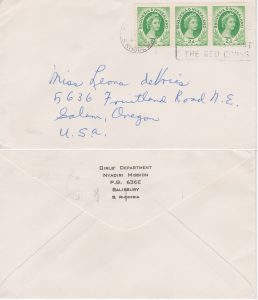
Vivian Otto joined the WFMS staff beginning 1953 and Miss Evelyn deVries served there as of September 1960.  The school (referred to as the “Girls’ Department” by the early 1960s) was still in operation as of 1995

Proctor’s Garage

Proctor’s Garage

Broken Hill

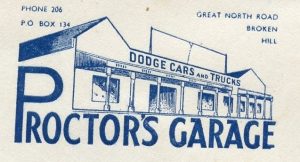
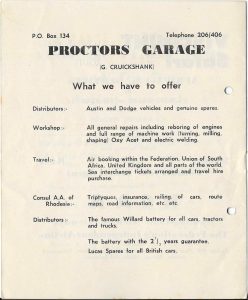
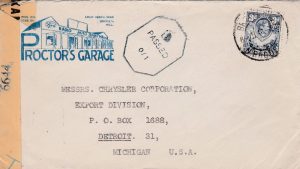
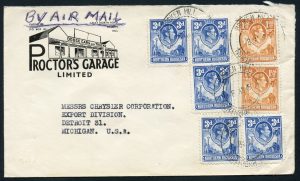
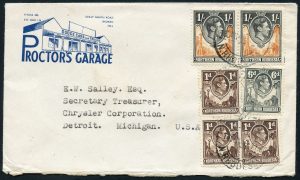
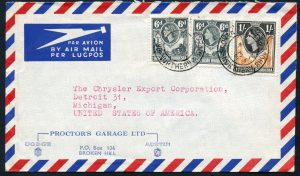
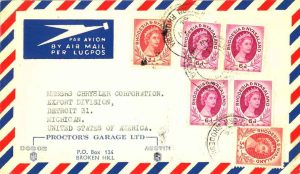
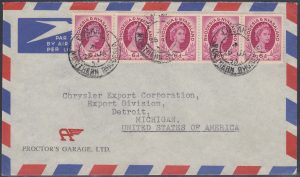
Proctor’s Garage was a dealer for Austin and Dodge vehicles. Not much is known of the origins of this business except that in the mid-1950’s Car Mart, Ltd., the largest Austin distributors in Britain, acquired controlling interest in Proctors Garage, Ltd and their several branches, and Neill Motors Ltd, a company which also had a number of branches.

Contributors
  • James Gavin

Elephant Hills Resort

Elephant Hills Resort

Victoria Falls

The resort has successfully hosted global conferences such as CHOGM 1991, the Solar Summit in the 90s, and recently the 20th Session of the UNWTO Assembly in 2013, Routes Africa and the 34th SADC Summit in 2014.

Postcards

References

The London and Lancashire Insurance Co. Ltd.

The London and Lancashire Insurance Co. Ltd.

Salisbury

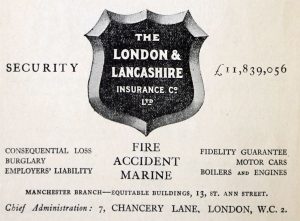
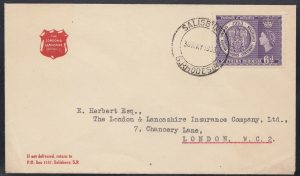
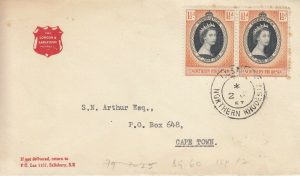
The London and Lancashire Insurance Co. Ltd was established in London in 1862. The company showed an early interest in South Africa and appointed an agent in Cape Town in 1862.

In 1867, a sister company, the London and Lancashire Fire Insurance Company, was established offering fire insurance. The two companies shared premises in Liverpool. From 1910, the company started to transact fire, accident, employers’ liability and general insurance.

By 1897, they had agents in Rhodesia. Eventually, branches were opened in major centres. The company was de-registered in 1975.

Revenue

Contributors
  • James Gavin

FB

Cecil Roberts & Letts

Cecil Roberts & Letts

Bulawayo

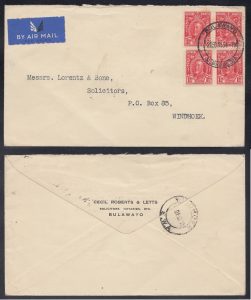
Cecil Roberts & Letts was a Bulawayo legal firm.

Agents for

Revenue

FB

H. E. Jackson & Co Ltd

H. E. Jackson & Co Ltd

Salisbury

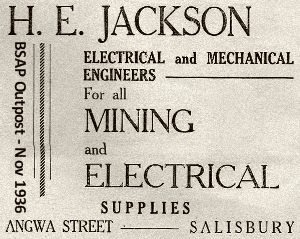
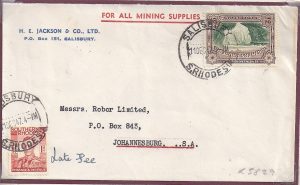
H E Jackson & Co Ltd were electrical and mechanical engineers based in Salisbury.

Revenue

  • Revenue Documents

References

Contributors
  • James Gavin
  • Walter Herdzik
  • Keith Harrop

FB

Wightman & Co. Ltd

Wightman & Co. Ltd

Bulawayo/Gatooma/Salisbury

Branches

Revenue

References

Contributors
  • James Gavin

FB

1 40 41 42 43 44 51