The Manica Trading Company Ltd: Gwelo
The Manica Trading Company Ltd
Gwelo

The Rhodesian Study Circle is a philatelic website for the areas of Rhodesia, Northern Rhodesia, Southern Rhodesia, British Central Africa and Nyasaland, Malawi, Zambia and Zimbabwe.
Gwelo
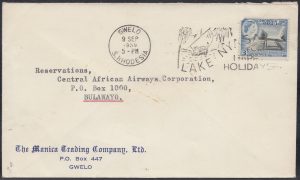

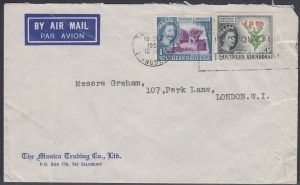
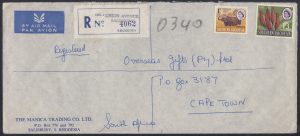
The Manica Trading Company Ltd was founded in Beira, Portuguese East Africa in 1890 by Julius Alston and Joseph Van Praagh. With its base in Beira, a branch was established at Old Umtali, Rhodeisa. In 1892, the company was floated.
Operations were carried on as General Merchants, Importers and Agents and soon another branch was opened in Salisbury. Julius Alston moved his residence to Salisbury and eventually in 1903 left Rhodesia for Melbourne, Australia and never returned. Further stores were opened in Bulawayo, Fort Victoria and Charter.
The first business relied on the import of all kinds of goods and on the establishment of business relations with a large number of shipping agencies. Its business stability, however, firmed its position in the years of the two World Wars, during which the situation was completely unfavourable to business expansion. The first great moment of consolidation took place during the 1st World War, both in Beira and in Southern Africa, through the increase of exports of goods – chrome, minerals, sugar, maize, cotton and rubber – from Africa to Europe.
In 1927, in the verge of a new depression context that erupted in 1929 and brought down the economy, Manica managed to close a contract deal for freight services of vast quantities of tobacco. Its prominence in the transport of tobacco along with the new challenge of air services led the company to enter the business of travel services, a service requested by many of Manica’s customers. Increased activity resulted in the opening of a travel agency, a relevant element in the organization’s portfolio.
In the 1950’s, the geographic universe of the company’s operations covered the entire region of Southern Africa, and Manica was involved in exports to destinies such as Europe, Venezuela and Japan.
In November, 2000, Manica went through a profound structural change, as part of a regional initiative, and became a totally Mozambican company. The Manica Trading Company is one of the oldest commercial enterprises. Due to it’s commercial activities, it continues to flourish, and it toady mainly concerned with
forwarding, insurance and similar activities.
Salisbury
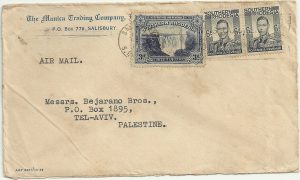

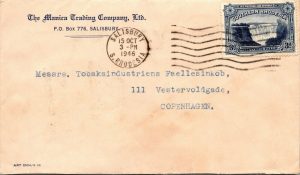
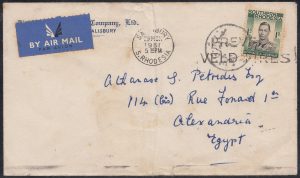
Salisbury

Rio Tinto Southern Rhodesia Ltd was incorporated on 29th August, 1956. It was set up initially to develop and mine the Empress Nickel deposit in Gatooma and was the first mining operation to be set up outside Europe by Rio Tinto plc in March, 1957. By 1959 it acquired the Cam and Motor Mines at Eiffel Flats.
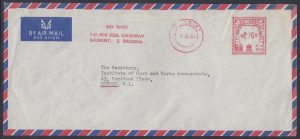
From 1965-1979, Rio Tinto (Rhodesia) Ltd detached itself from the parent company, grew into the single largest money earner and sanctions-buster, exporting millions of pounds worth of nickel, emeralds and tin, as well as becoming one of Zimbabwe-Rhodesia’s most successful manufacturers.
In September 1968, Rio Tinto (Rhodesia) Ltd closed the Cam Mine and established the Empress Nickel Mine. By 1969, the Rio Industries was established and in 1975 the Renco Mine was purchased. Renco mine was eventually opened in 1982 and the Empress Mine closed.
Rio Tinto Zimbabwe Ltd separated from Rio Tinto plc in 2004 and became the wholly owned Zimbabwean company (RioZim Ltd) that produced gold, coal, toll refines nickel and copper. Rio Tinto exited Zimbabwe in 2015.
Kitwe

Faith’s Orphans Fund (FOF) ministers to over 3500 HIV/AIDS orphans in rural Zambia through 16 centers set up across the country. This efficient ministry model does not include the ownership of orphanages, but rather empowers existing villages through the provision of clothing, rural teachers, school fees, horticultural training and supplies to provide for the many orphaned children within the area.

Touched by the despair of the children left behind, Faith Mukumbo Liyena a young Christian nurse at the Mukinge Mission Hospital, made it her first priority to offer hope to these children. After careful planning, the Faith Orphanage Foundation was born in 1992 and registered in 1993 as a Non-Governmental Christian Charitable Organisation.

What begun as a humble concern for children orphaned largely as a result of the HIV/AIDS epidemic throughout Africa, the vision of FOF has become internationally recognised, and they are now caring for 2,500 orphans.
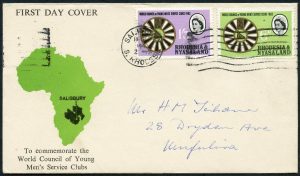
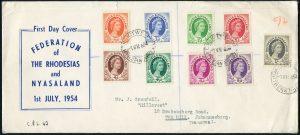
First Day Covers – Rhodesia & Nyasaland





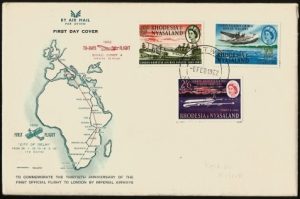
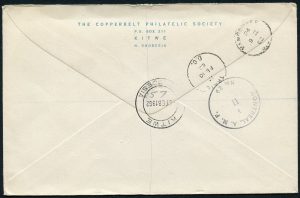


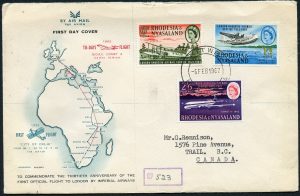
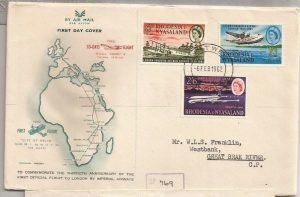
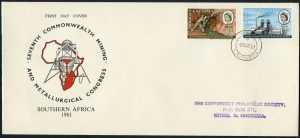
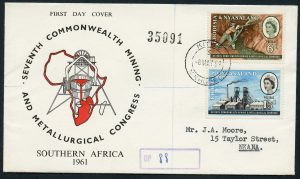


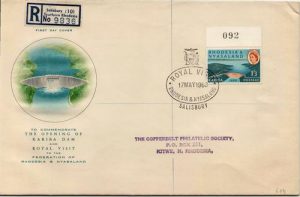
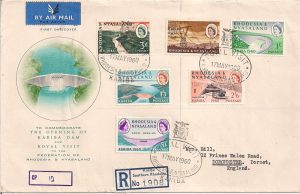


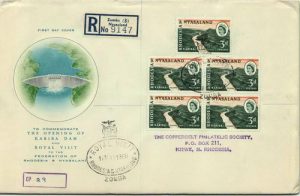
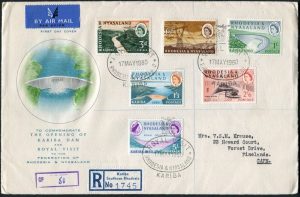


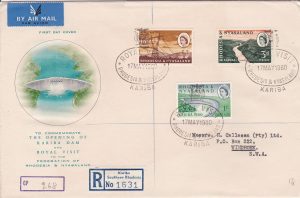


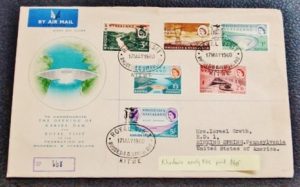

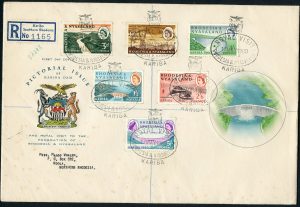



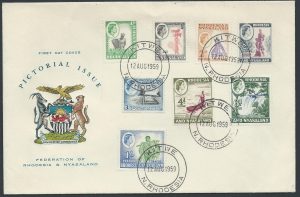
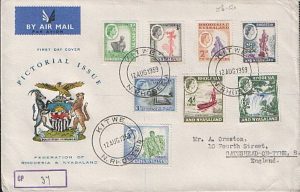


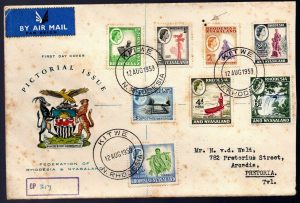

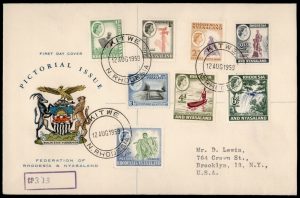

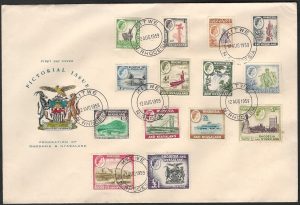




Salisbury

Bulawayo
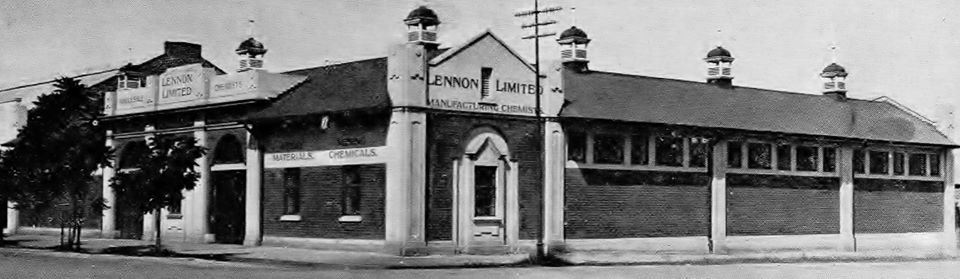
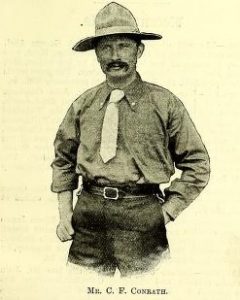
The Bulawayo branch of Lennon Limited opened in 1894 and was first managed by Mr. C. F. Conrath, and later by Mr. Charles Cattel in 1895. During that time, the premises were at the corner of Fife Street and Sixth Avenue.
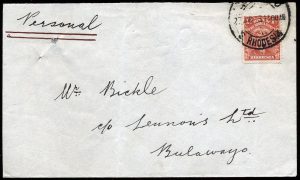
The firm was joined in 1897 by Mr. W. J. Brickle, who later became manager after Mr. Cattel left for England in 1900. New premises were acquired in Selborne Avenue in 1902.
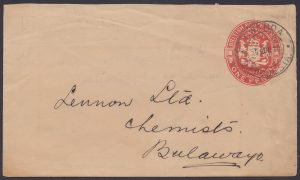
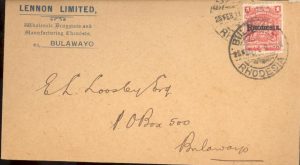
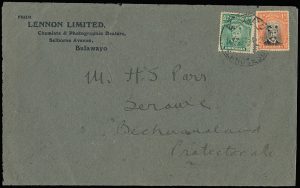
Lennon’s, as part of their business, promoted the sale of photographic goods for their customers including postcards.
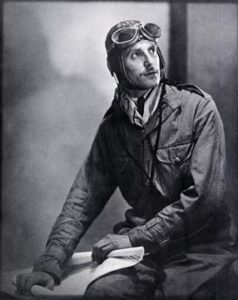
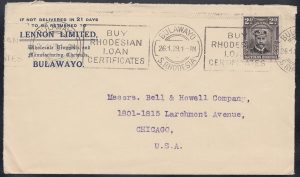
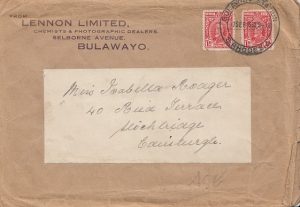
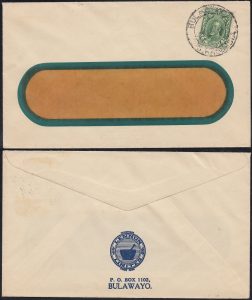
In a 1930 advertisement they were “doing photography” and in 1937 their Photographic Department in Bulawayo was managed by Edward Roper Yerbury. Yerbury was a trained photographer from Edinburgh and secretary of the Rhodesia Photographic Society when it staged its exhibition in Bulawayo in July, 1939. He tragically died in a motorcycle incident in Bulawayo in June, 1940.

However, by 1953, in their advertisement in “The City of Bulawayo Official Guide” they made no reference to photographic goods or to photography. It would appear the Abercorn Street Chemists shop had closed as their current advertisement only gave the address of 67a, Fife Street, Bulawayo.
Bulawayo

The origins of the Scouting Association can be traced back to the Second Matabele War when Robert Baden-Powell and Federick Russell Burnham, the American born Chief of Scouts for the British Army first met and begun a lifelong friendship. Burnham had been a scout practically his entire life in the United States when he went to Africa in 1893 to scout for Cecil Rhodes on the Cape-to-Cairo Railway.
In mid-June 1896, during their joint scouting patrols in the Matopos Hills, Burnham began teaching Baden-Powell woodcraft, inspiring him and giving him the plan for both the program and the code of honor of Scouting for Boys. These skills eventually formed the basis of what is now called scoutcraft, the fundamentals of Scouting.
Both men recognised that wars in Africa were changing markedly and the British Army needed to adapt; so during their joint scouting missions, Baden-Powell and Burnham discussed the concept of a broad training programme in woodcraft for young men, rich in exploration, tracking, fieldcraft, and self-reliance.


In 1909 three boys, having acquired a copy of Scouting for Boys decided to become scouts. These three boys were the start of the 1st Bulawayo (Pioneer) Boy Scout Group. By 1910 the group began to take shape, under the leadership of the Rev. T.O.Beattie. He held meetings twice weekly in a small tin hut, nicknamed the “Bishop’s Palace”.
Scouting grew quickly and in 1924 Rhodesia and Nyasaland sent a large contingent to the second World Scout Jamboree in Ermelunden, Denmark. The great popularity of the Boy Scout movement in Rhodesia was due to its outdoor program such as hiking, camping, cooking and pioneering, which was unusual in the protectorate. Additionally, the training and progressive badge system was targeted towards helping others, leading to responsible citizenship.

Because of the prevailing circumstances earlier in the 20th century, a separate movement was established for black Africans called “Pathfinders”. By the 1950s the time was considered to merge both movements into one Scout Association, as was done with the South African Scout Association.

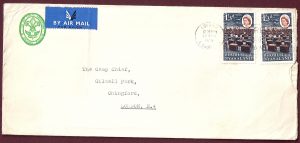
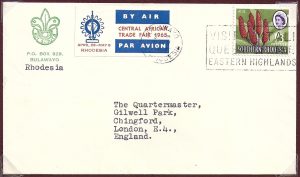
During the years of 1960-1979, Scouting in Rhodesia lost a large number of members in the outlying rural areas. Accordingly, the revival and expansion of Scouting in these areas is a prime target at this time.

In 1980, after independence, it became known as the Zimbabwe Boy Scouts Association and became an independent member of the World Scout Conference.


The Scout & Guide Stamps Club was founded as the Scout Stamp Collectors Club (SSCC) in 1957 as a result of the increased interest created by the numerous stamp issues commemorating the Baden-Powell Centenary and the Golden Jubilee of Scouting. The first meeting was held on February 20th 1957 at the Headquarters of the International Bureau in London followed by an open meeting at the 9th World Jamboree at Sutton Coldfield.
Club membership exceeds 300 from over 30 countries and extends to collectors of Scout and Guide stamps, postal history of Scout & Guide events, special postmarks, slogans and meter cancellations, labels (seals) and postcards.
Membership is open to anyone who is interested in this popular thematic subject and close co-operation is maintained with similar clubs in the U.S.A. and many European countries.
The leading collectors of the world, specialising in Scout and Guide thematics, are members of the SGSC and their expert knowledge and advice is available to fellow members.