Buluwayo Board of Executors & Trust Co Ltd

Buluwayo Board of Executors & Trust Co Ltd

Bulawayo

Bulawayo Board of Directors and Trust Co Ltd was founded in 1895 and is one of the oldest companies in Zimbabwe. The original members were Henry Lamb, W G Swanson, Julius H Pratt and E J Simpson.

Contributors
  • James Gavin

FB

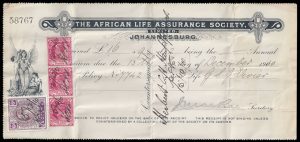
The African Life Assurance Society Ltd

The African Life Assurance Society Ltd

Salisbury

The African Life Assurance Society Ltd was established by Isidore Williem Schlesinger at the end of 1904 with the £20,000 he had earned from the development of the suburb of Parkhurst, Gauteng, South Africa. During its first year in business, the company sold 2,274 policies worth £1 million, a record for a new business in the industry at the time.

In 1905, he bought the financially struggling Robinson South African Bank (founded by J.B. Robinson) and converted it into the Colonial Banking and Trust Company, which specialised in small business loans. In 1911, he founded the African Guarantee and Indemnity Corporation to provide all types of insurance.

The company had branches and agencies in the Union as well as in Khartoum, Assouan, Syria, Cairo and Alexandria. In 1912 it expanded its operations to Natal and amazement was expressed at the large volumes of new business that it generated. By 1925, the business was one of the four dominant insurance companies in South Africa.

African Life is now part of the SANLAM group.

FB

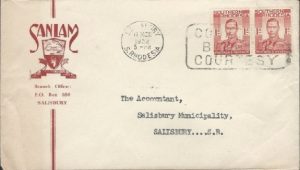
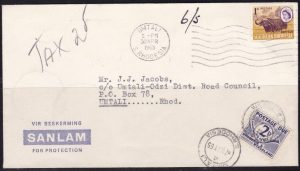
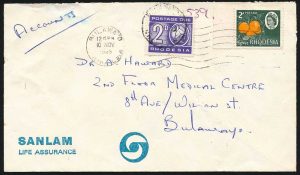
SANLAM

SANLAM

The Suid-Afrikaanse Nasionale Trust en Assuransie Maatskappij Beperk (South African National Trust and Assurance Company Limited), Santam, was registered on 28 March 1918. It was then decided to convert the life assurance department into a separate company, and the Suid-Afrikaanse Nasionale Lewens Assuransie Maatskappij Beperk (South African National Life Assurance Company Limited), Sanlam, was registered on 8 June 1918.

Sanlam, the subsidiary, later became the spearhead of the operation, while Santam remained focused on short-term insurance. Santam remained the controlling shareholder until 1954 when Sanlam became an independent mutual life assurance company, as well as the largest single shareholder in Santam.

Sanlam Group has developed over time into a diversified financial services business. Through its business clusters – Sanlam Personal Finance, Sanlam Emerging Markets, Sanlam Investments, Sanlam Corporate and Santam.

The group’s areas of expertise include insurance, financial planning, retirement annuities, trusts, wills, short-term insurance, asset management, risk management and capital market activities, investment and wealth. The group operates in South Africa, Namibia, Botswana, Swaziland, Malawi, Zambia, Tanzania, Rwanda, Uganda, Kenya, Ghana, Nigeria, Mozambique, India, Malaysia and the UK and has business interests in the US, Australia and the Philippines. It has a stake in micro-insurance specialists, UK-based Micro-Ensure Holdings Limited, which has a footprint across Africa and India servicing more than 10 million enrolled clients.

Reference

FB

Universal Postal Union

Universal Postal Union

The Universal Postal Union (UPU) is a specialised agency of the United Nations (UN), established in 1947, that regulates international mail services with its headquarters at Bern, Switzerland.

Established in 1875 following adoption of the Universal Postal Convention, it is one of the oldest extant international governmental organisations. The Universal Postal Congress, the governing body, usually meets every four years to discuss and adopt a world postal strategy and consider the activities of the executive council, whose 40 members are elected on a geographical basis and meet yearly.

The UPU consists of:

  • 4 bodies
    • The Congress
    • The Council of Administration (CA)
    • The Postal Operations Council (POC)
    • The International Bureau (IB)
  • 2 cooperatives
    • Telematics Cooperative
    • EMS Cooperative

Countries that belong to the union form a unified postal territory with easy international exchange of mail. The union also provides technical assistance and advice in attempts to improve postal service, especially in developing countries. It facilitates the development of the contemporary postal network which, in addition to the traditional delivery of mail, also includes electronic and financial services. The UPU has 192 member nations.

Events

Stamp Issues

References

Edmund Henry Allott

Edmund Henry Allott

(1881-1964)

Edmund Henry Allott was born 15 October 1881 in Walton, Warwickshire the son of Henry Hepworth Allott, a Curate with the Church of England and his wife Alicia Georgina.

At the the age of 19, Edmund was employed as a Land Agent’s Assistant. On 25 June 1901 Edmund Henry Allott joined the Boer War an was appointed as a Second Lieutenant with the 3rd Battalion of the Lincolnshire Regiment. For his efforts he was awarded the Queens Medal with clasps Cape Colony and South Africa 1902.

Having returned to England on 12 September 1902 after the cessation of hostilities, Allott continued on in the Volunteer force being Gazetted a full Lieutenant with effect from August 1902. He commenced studying and undertook a voyage to the United States from London in 1904, with his final destination Kamloop in British Columbia (Canada). When he returned to England, he devoted his energies to farming for his own account and the next event of any import in his life was on 25 January 1907 when he resigned his commission and was made an Honorary Lieutenant. 

When the Great War erupted in 1914 Allott put his hand up for the war effort and was appointed into the 19th Divisional Supply Company of the Army Service Corps. But before he was to see any military action, he married Miss Olive Millicent Brooks. He was posted to France on 14 July 1915 where he was deployed to a variety of front line positions and was promoted to Captain.

Post-war, he tried to settle down as a Farmer, however the venture wasn’t a long lasting one and he began to turn his attention towards Africa. On 21 February 1929 he departed from London aboard the “Dunluce Castle” bound for Cape Town and eventually Melsetter, Southern Rhodesia (on advice of his cousin Bill Hanmer).

The Allott’s lived for 6 months at Fairview in an enormous rondavel which served as bedroom, living room and kitchen, and when the Hanmer’s went away the Allott’s were entrusted with the care of the farm and the job of making a new road to Heathfield. After leaving Fairview the Allott’s camped on Welgelegen, a farm they were tempted to buy, but settled in the end for Belmont and Belmont Valley where they went raised horses and cattle. By 1934 Allott had turned his hand to growing coffee achieving 100% success with seedbeds of Caffea Arabica planting over 1000 trees.

In 1932 Allott bought the Melsetter Hotel, hoping to provide more attractive accommodation for tourists, boost the district, and provide an outlet for the fresh produce from his farm Belmont. In 1935 Allott decided to run the hotel himself, despite having had no experience “he won a good reputation”, installing electricity and erecting 10 prefab bedrooms to which a swimming pool was added in 1938. With the outbreak of the Second World War in 1939 Allott and his wife were left to try and carry on with the hotel as best they could with a drastically depleted staff and very little business. They both volunteered for service but were turned down, the hotel was deemed to be an essential business and had to be carried on. Local Air Force chaps were the only visitors and they were put up for free.

Emerging relatively unscathed from the war Allott continued on with the hotel until he reached the age where he couldn’t carry on. He passed away at the age of 83 at his farm, Belmont Valley in Melsetter on 12 November 1964 and was survived by his wife and daughters Rosemary Joan Owen and Olivia Josephine Webb.

References

FB

Netherlands Bank of Rhodesia Limited: Gwelo

Netherlands Bank of Rhodesia Limited

Gwelo

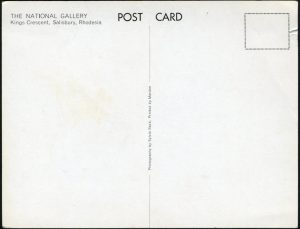
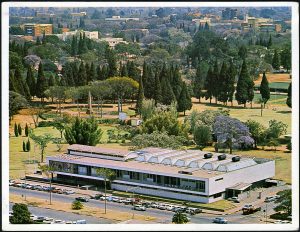
Postcards: National Gallery of Rhodesia – Type I

National Gallery of Rhodesia

Type I

No.sDescriptionEarliest PMK Date
N/AThe National Gallery

FB

National Gallery of Rhodesia

National Gallery of Rhodesia

Salisbury

The National Gallery of Rhodesia was initially planned in the 1930s, but the outbreak of the Second World War impeded the colonial government’s involvement in its progress. However, the idea was given new life when in 1943, Sir James McDonald, a friend and colleague of Cecil John Rhodes, left a bequest of £30,000 to establish an art gallery and art museum in Salisbury, Southern Rhodesia.

At the end of 1953, the Inaugural Board of the Gallery was established, chaired by the Governor of Southern Rhodesia. The passing of the National Gallery Act of Parliament in early 1952 saw the dissolution of the Inaugural Board and the establishment of the Board of Trustees.

The Gallery was conceived as a national institution, representing Southern Rhodesia, Northern Rhodesia, and Nyasaland, governed from 1953 to 1963 as a united Federation. Salisbury City Council agreed to take full responsibility for overseeing the building, establishment and administration of the Gallery, and the Mayor of Salisbury was made a fixed appointee to the Board of Trustees. The first responsibilities of the Board were to establish funds for the building, to select the building design, and to appoint a Director. They next established funds for the running and administration costs of the Gallery, and made provision for an endowment fund for the acquisition of a permanent collection. At that time, the building funds consisted only of the McDonald bequest and a further £150,000 had yet to be raised. It was decided that an appeal should be launched among local businesses in support of building a gallery in Southern Rhodesia.

The National Gallery of Rhodesia was designed and directed by Frank McEwen, a British citizen credited with bringing Shona Sculpture to the spotlight. The Gallery was officially opened by The Queen Mother on 16 July 1957 as part of her Royal Tour. McEwen was curator of the Gallery from 1957 until his resignation in 1973.

It is now the National Gallery of Zimbabwe.

Stamp Issues

Postcards

Contributors
  • Geoff Brakspear

Rhodesia United Air Carriers

United Air Carriers

Harare

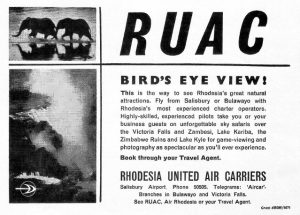
Rhodesia United Air Carriers (RUAC) was a company formed in 1957 by the amalgamation of several existing charter companies; Air Carriers Limited and Flights (1956) Limited of Salisbury, and Fishair of Victoria Falls.

Commercial Air Services (Rhodesia) of Bulawayo was integrated into RUAC in August 1960, following the merger of its holding company, Airwork Ltd (also known as Airwork Services), with Hunting-Clan (which had owned Air Carriers Ltd), a subsidiary of the maritime company Clan Line.

RUAC was the Beechcraft agent for Central Africa. It operated a fleet of Beech Barons, a Beech Queen Air, several Piper Apache and Aztec aircraft, a Cessna 180 and a Britten-Norman BN-2 Islander.

The company had bases at Salisbury (head office and maintenance base), Bulawayo and Victoria Falls.

Postcards

Postcards: Salisbury Publicity Association – Type IA

Salisbury Publicity Association

Type IA

No.sDescriptionEarliest PMK Date
N/ASalisbury, Rhodesia22/08/1971

FB

1 26 27 28 29 30 89