1979 – Ceasefire Agreement

Ceasefire Agreement

21 December 1979

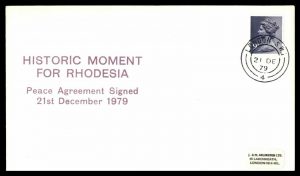
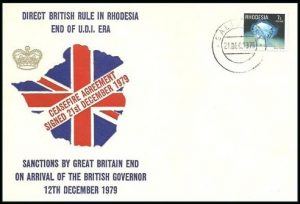
The Lancaster House Agreement, signed on 21 December 1979, declared a ceasefire, ending the Bush War. Crucially, the political wings of the black nationalist groups ZANU and ZAPU, who had been waging the escalating, and increasingly violent insurgency, would be permitted to stand candidates in the forthcoming elections. This was however conditional to compliance with the ceasefire and the verified absence of voter intimidation.

Commemorative Covers

Other Covers

FB

Salisbury Stamp Co (Pvt) Ltd: Commemorative Covers – Political Covers

Salisbury Stamp Co (Pvt) Ltd

Commemorative Covers – Political Covers

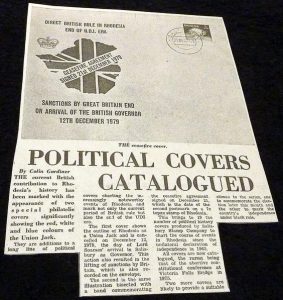
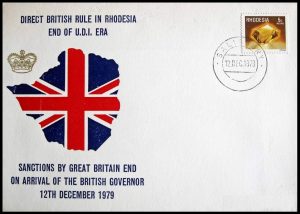
The Salisbury Stamp Co (Pvt) Ltd produced a number of political commemorative covers during the Unilateral Declaration of Independence by Rhodesia. Up to 21 covers were produced.

1979 – Ceasefire Agreement (19)
1979 – Direct British Rule in Rhodesia (18)

The African Fine Art & Book Co: Last Day of Rhodesa/First Day of Zimbabwe Rhodesia

The African Fine Art & Book Co

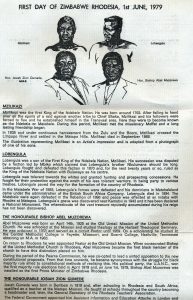
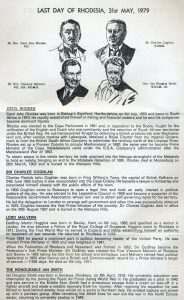
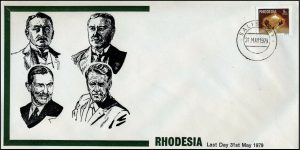
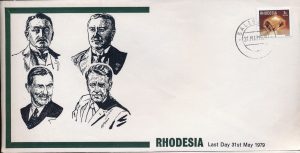
Last Day of Rhodesa/First Day of Zimbabwe Rhodesia

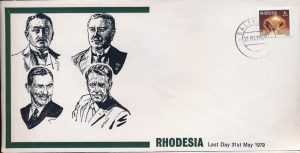
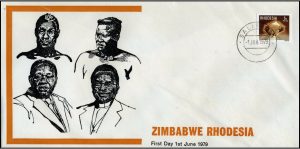
The African Fine Art & Book Co produced a limited edition of 1500 pairs of covers to commemorate the Last Day of Rhodesia/First Day of Zimbabwe Rhodesia. The covers were drawn and designed by Ned Etheridge.

  • No.1-400 were signed and numbered by the artist
  • No.401-1500 were numbered by the publisher.

Last Day of Rhodesia

First Day of Zimbabwe Rhodesia

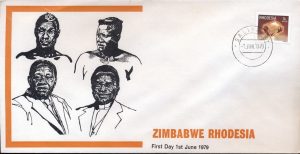
1979 – First Day of Zimbabwe Rhodesia

First Day of Zimbabwe Rhodesia

1 June 1979

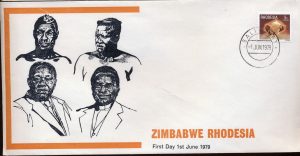
Zimbabwe Rhodesia was an unrecognised state that existed from 1 June 1979 to 12 December 1979. Zimbabwe Rhodesia was preceded by an unrecognised republic named Rhodesia and was briefly followed by the re-established British colony of Southern Rhodesia, which according to British constitutional theory had remained the proper government after Unilateral Declaration of Independence in 1965. About three months later, the re-established colony of Southern Rhodesia was granted internationally recognised independence as the Republic of Zimbabwe.

Abel Tendekayi Muzorewa, also commonly referred to as Bishop Muzorewa, served as Prime Minister of Zimbabwe Rhodesia from the Internal Settlement to the Lancaster House Agreement in 1979. A United Methodist Church bishop and nationalist leader, he held office for only a few months.

Commemorative Covers

The two sized covers (below) were presented in a specially printed linen folder, bound (above).

Other Covers

FB

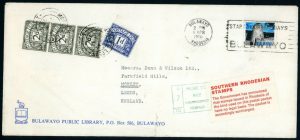
Bulawayo Public Library

Bulawayo Public Library

Bulawayo

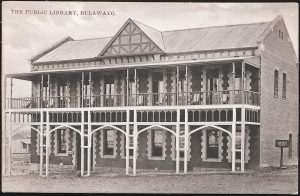
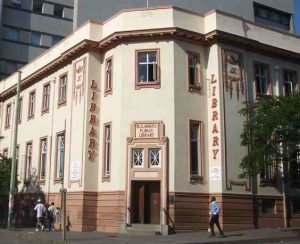
The Bulawayo Public Library was founded 1896 when the European settlers established public libraries to cater for their information, recreational, educational and cultural needs. A twelve man library Committee was chosen to run the facility and their major role was to fundraise for the library.

A foundation stone of the 8th Avenue /Fort Street site was laid on the 5th of November 1897 by Lord Milner during his visit for the opening of the Railway. In 1902 the library also house The Rhodesia Museum.

Since its establishment the library has remained popular to many readers in the city of Bulawayo and the whole of the Southern Region. The services that this library provides are largely as a result of enthusiasm and energy given over many years by the committees,librarians as well as staff members. The institution is registered in terms of the welfare Organizations Act (Chapter 93).

References

FB

Leopard Rock Hotel

Leopard Rock Hotel

Vumba

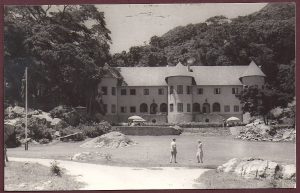
Leopard Rock Hotel was built and opened by the Seymour-Smiths in 1946. The Seymour-Smiths were a well-known local family who decided after the Second World War that a need existed for a holiday hotel at the top of the Bvumba Mountains.

When opened, the hotel offered accommodation for up to 40 guests, reached by travelling up a gravel road which climbed hundreds of metres from Umtali and wound through the mountainsides. A simple but amusing nine-hole golf course was built on the hotel’s estate and the hotel promoted itself as a venue for people who enjoyed the invigorating climate and communing with nature.

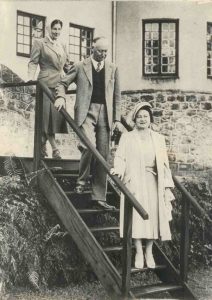
As part of the 1953 Royal Tour, the Queen Mother and Princess Margaret stayed at the hotel and were so taken with the hotel and its spectacular surroundings that she was inspired to pen these words for posterity; “There is nowhere more beautiful in Africa.”

Leopard Rock Hotel was then purchased by the Taberer family in the 1990s and a major expansion project was undertaken, which saw the construction of a new bedroom block –increasing the number of available rooms and suites to accommodate 120 guests. The hotel is now owned and operated by Cambria Africa plc previously Lonzim.’

In 2011 and 2012, the hotel was named Best Resort Hotel in Zimbabwe by the Association of Zimbabwean Travel Agents in their respected annual awards event. In 2013, CNN Travel named the Leopard Rock golf course one of Africa’s 10 best golf courses.

Postcards

References

FB

Postcards: The Montclair Hotel – Type I

The Montclair Hotel

Type I

FB

Rhodes Inyanga Hotel

Rhodes Inyanga Hotel

Rusape

Rhodes Inyanga Hotel was originally built as a holiday cottage in the 1800’s by Cecil John Rhodes.  Rhodes’s bought the old Fotheringhame’s homestead on Fruitfield Farm in 1896.  “Mr Rhodes built himself a retreat; and this was always his solitude where he preferred to think out his great schemes.”

In 1918 the Estate at Nyanga was delegated to the Department of Agriculture. Later still it was decided that the orchards should be leased from the Estate by the Ministry of Agriculture and run as a Horticultural Experiment Station.  Other parts of the Estate are leased to the Forestry Commission and The Wattle Company, and farming operations were carried on until 1933.

In that year it was decided to develop the area as a tourist resort. Rest camps were erected at various beauty spots and roads were built so that tourists could visit the different sites on the Estates. The original homestead on the Estate was modernized to form the present Rhodes Nyanga Hotel in 1933, about three decades after his death.


It is currently known as the Rhodes Nyanga Hotel and continues to operate.

Postcards

References

FB
Aerogrammes of British Central Africa

Aerogrammes of British Central Africa

This listing will deal with the special printed forms used in the three countries of British Central Africa as a means of providing an inexpensive air mail service using a custom designed air letter form. It is not confined to postal stationery (that is stationery produced bearing an imprinted valid postage stamp and sold by or on behalf of a postal authority) but will include air letter sheets and aerogrammes issued without an imprinted stamp, provided there is evidence of the use of that form of air letter sheet or aerogrammes in one or more of the countries.

As and when new information is received the relevant chapters will be updated and republished. Please note that this could involve the renumbering of the items within a chapter. Be sure to always use the latest update, which will be dated.

If you would like to contribute any information, please Contact Us.

Many thanks,
Adrian de Bourbon
November 2019

Chapters

Contributors

  • Hugh Amoore
  • Sean Burke
  • Geoff Brakspear
  • Tony Banks
  • James Gavin
  • Keith Harrop
  • Barry Horne
  • Narendrha Morar
  • Dave Trathen
  • Otto Peetoom
  • Allan Rendle
  • Stuart Ross
  • Mark Thomas
1 3 4 5 6