Lilongwe Philatelic Society

Lilongwe Philatelic Society

Lilongwe

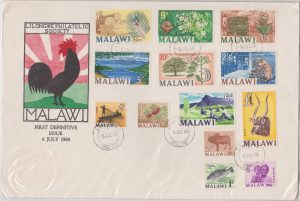
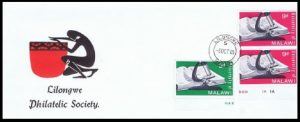
The Lilongwe Philatelic Society was created by John Lanham, a Posts & Telecommunications worker who lived in Lilongwe. Although the society did not hold any meetings or events, it appears the main purpose was to create philatelic covers during the 1960’s in which Lanham believed would be superior to those issued by official postal authorities.

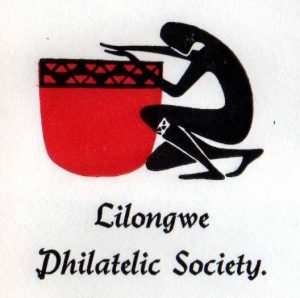
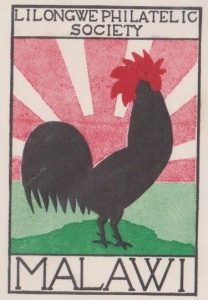
Originally, covers bore the emblem of the cockerel against a background of a rising sun. However, the postal authorities considered the emblem sacrosanct unto them and it was changed to a native drummer for future issues.

First Day Covers

References


Charles Stewart Day Old Chicks (Pvt) Ltd

Charles Stewart Day Old Chicks (Pvt) Ltd

Hartley

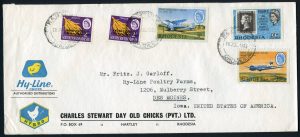
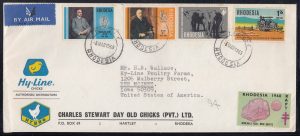
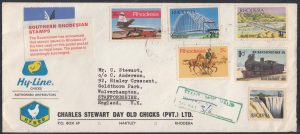
Charles Stewart Day Old Chicks is a family business established in 1958 by Charles Stewart. Initially producing one day old chicks, after a few years the business began exporting day old chicks and breeding stock to Malawi(1971), Mozambique, and Northern Rhodesia (Zambia).

Today, the company employs over 500 staff and stocks broiler chicks, layer chicks, stock feeds, Hy-Line breeding stock vaccines and medication. The business’ headquarters is in Blantyre, Malawi.

Contributors
  • James Gavin
  • Walter Herdzik

FB

Bible Society of Malawi

Bible Society of Malawi

The Bible Society of Malawi is a full member of the United Bible Societies. It was established in the early 1960’s in Blantyre by a Southern Rhodesian named Rev. Dennison Nyamurowa.

In August, 1979, Rev. Nyamurowa returned to Rhodesia and was replaced by Rev Chienda as the Executive General Secretary of the Society.

Committed to serving the Lord Jesus Christ and His Church in Malawi in ensuring the availability of the affordable Holy Scriptures which are faithful to the original texts, without doctrinal note or comment in various formats and media for worship, witness, discipleship and spiritual growth through Translation, Production, Distribution and Non-print Media Programmes.

References


United Bible Societies

United Bible Societies

As early as 1932, the British and Foreign Bible Society and the American Bible Society began to co-ordinate their efforts to reach more people across the globe. By 1946, just after the end of World War II, 13 Bible Societies (including the British and Foreign Bible Society) met together and agreed that Bible Societies all around the world would be stronger if they worked together. They agreed to create the fellowship of Bible Societies known as the United Bible Societies with the original headquarters based in London and Geneva.

Bible Societies

Seventh-Day Adventist Church

Seventh-Day Adventist Church

The Seventh-day Adventist Church (SDA) is a Protestant Christian denomination with a number of distinguishing beliefs, including the observance of Saturday as the Sabbath (“Biblical Sabbath”) and emphasis on the imminent “Second Coming” (advent) of Jesus.  The church is rooted in the Millerite movement of the 1830s – 1840’s.  Based on their interpretation of the Bible, the Millerites believed Christ would return to earth in October 1844.  The SDA church was formerly established in 1863.

The Seventh Day Adventist missionaries came to Africa in July 1887. The “Cape Conference” was organized in 1892 with headquarters at Cape Town.  There was an early interest in “carrying the gospel” north to the “Matabeles” in Southern Rhodesia (Zimbabwe) “but owing to the hostility of the native rulers, little progress was made until in 1893 Lobengula was overthrown, and the British government took possession of the country.”  The following year, a missionary party arrived in Bulawayo and established the Solusi mission on a grant of 12,000 acres secured from Cecil Rhodes.  From Solusi, many other missions were later established in Southern and Northern Rhodesia (Zambia) and Nyasaland (Malawi).

As of 2016, the Zimbabwe Union Conference (providing administrative oversight for Zimbabwe), had membership of 885,000; the Malawi Union Conference had membership of 516,000 and the Southern and Northern Zambia Union Conferences had a combined membership of 893,000.  Globally, as of 2007, there were over 20 million members in 215 countries and territories (the twelfth largest religious body in the world).

Divisions

Mission Fields

Unattached Missions

Institutions

Missions

Southern Rhodesia
Northern Rhodesia
Nyasaland
Zimbabwe

References

Contributors
  • Mark Loomis

United Nations Development Programme

United Nations Development Programme

The United Nations Development Programme (UNDP) was established in 1965, when two United Nations agencies – the Expanded Programme of Technical Assistance set up in 1949 and the Special Fund set up in 1958 – were merged by decision of the General Assembly.

By 1983, UNDP projects were being implemented in 170 countries covering nearly the entire economic and social spectrum – from industry to health, education, economic planning and public administration.

Regions

References

Contributor
  • James Gavin

FB

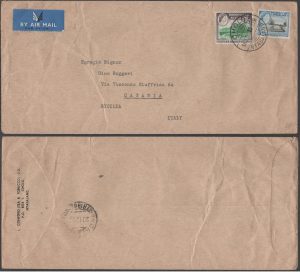
I Conforzi (Tea & Tobacco) Ltd

I. Conforzi (Tea & Tobacco) Ltd.

Cholo

Ignaco Conforzi (b.1885) was an Italian immigrant that brought with him a diploma of agricultural science to Nyasaland in 1907 as a manager with the Blantyre and East Africa Company. In 1909 he began his own tobacco plantation in the Cholo district. By the end of WWI, he was a major producer for the Imperial Tobacco Company.

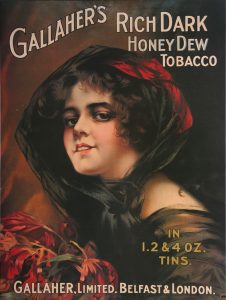
In 1923 he established a link with Gallaher Ltd, a Belfast tobacco company. It was here that his wealth developed. In the following year he began a successful plan to purchase tobacco from independent peasants in the Central Province. In 1928, he switched from tobacco to tea on his Cholo estates and also acquired substantial land holdings in the Lilongwe and Fort Manning districts.

By 1935 he owned 54% of the tobacco market, owning ten tobacco estates and six tea plantations. In 1939 he converted his private enterprise into a British-based company, I. Conforzi (Tea & Tobacco) Ltd. This ensured that when Britain declared war on Italy in 1940, the Government did not expropriate the company.

In 2001, the plantation went into liquidation and was acquired two years later by a Limbe-based Asian firm.

Reference

  • A History of Malawi 1859-1966 – John McCracken
  • Historical Dictionary of Malawi – Owen J. M. Kalinga
Contributors
  • James Gavin

FB

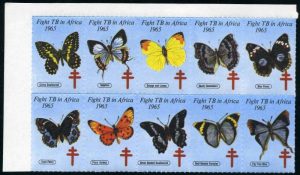
Cinderella: 1965 – Butterflies of Central Africa (Malawi)

Rhodesia Association For The Prevention Of Tuberculosis (RAPT)

Butterflies of Central Africa (Malawi)

This release is similar to the Rhodesian release of Butterflies of Central Africa but does not include ‘RAPT’ in the symbol.

Details

  • Date of Issue: 1965
  • Designer: 
  • Printer:
  • Process:
  • Paper:
  • Perf: Roulette
  • Sheet: 12 x 5
  • Booklet:
  • Quantity:

Harrisons & Sons: Pre-Production

Harrisons & Sons Ltd., London

Pre-Production

Malawi
Rhodesia & Nyasaland
Zambia
1 18 19 20 21 22 27