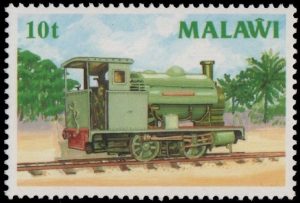
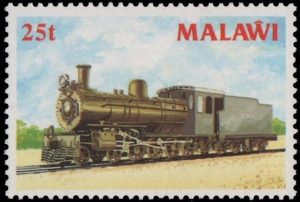
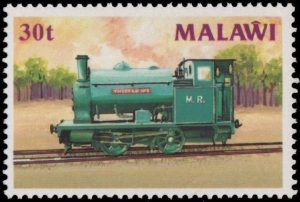
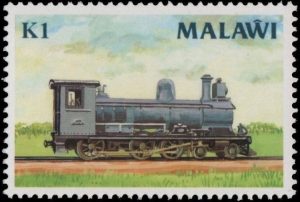
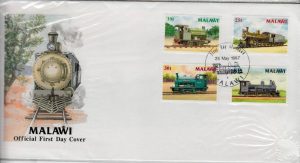
1987 – Steam Locomotives

Malawi

1987 – Steam Locomotives

Details

  • Date of Issue: 25th May, 1987
  • Date Withdrawn:
  • Date Invalidated:
  • Designer: 
  • Printer: Cartor S.A. 61300 L’Agile
  • Process: Lithographed
  • Paper:
  • Watermark: N/A
  • Perf: 14 x 13.5
  • Cylinders:
    • 1A 1A 1A 1A/1B 1B 1B 1B (30t)
    • 1C 1C 1C 1C/1D 1D 1D 1D (10t, 25t, 1k)
  • Sheet:
  • Booklet: N/A
  • Quantity:

Production Details

First Day Covers

Malawi – Stamp Issues: 1980-1989

Malawi

Stamp Issues: 1980-1989

Malawi

1989
1988
1987
1986
1985
1984
1983
1982
1981
1980

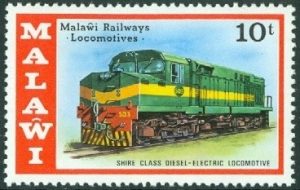
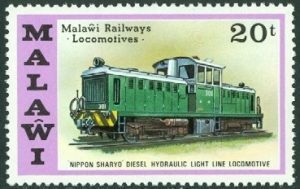
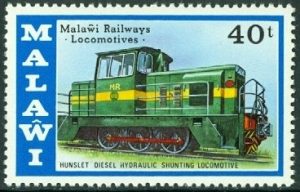
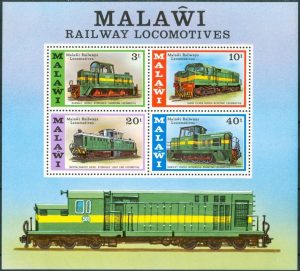
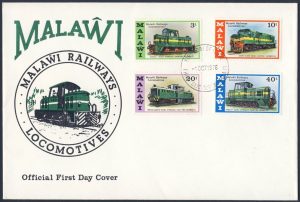
1976 – Malawi Railways Locomotives

Malawi

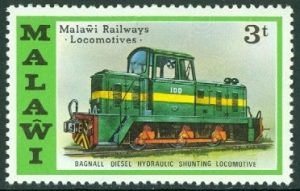
1976 – Malawi Railways Locomotives

Details

  • Date of Issue: 1st October, 1976
  • Date Withdrawn:
  • Date Invalidated:
  • Designer: G. Drummond
  • Printer: House of Questa
  • Process: Lithography
  • Paper:
  • Watermark: Cockerels (sideways)
  • Perf: 14.5 x 14
  • Cylinders:
  • Sheet:
  • Booklet: N/A
  • Quantity:

First Day Covers

FB

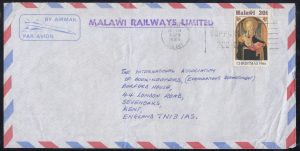
Malawi Railways Limited

Malawi Railways Limited

Nyasaland Railways Ltd was incorporated in 1907. After independence in 1964, Malawi inherited a network of three railways from the British and became Malawi Railways Ltd. They were the Shire Highlands Railway, the Central African Railway and the Trans-Zambezia Railway. The network was run as a single, integrated Malawian system, even though the Trans-Zambezia Railway was located entirely on foreign territory.

All of these lines were narrow gauge and single track, and the Shire Highlands Railway in particular had sharp curves and steep gradients, so the system was inadequate for heavy train loads. Maintenance costs were high and freight volumes were low, so freight rates were up to three times those of Rhodesian and East African lines.

Although costly and inefficient, the rail link to Beira remained a main bulk transport link until 1979 when it was destroyed by RENAMO forces in the civil war. By then, Malawi had its second rail link to the Mozambique port of Nacala, which is its principal route for imports and exports today.

From 1974 to 1979, Malawi worked with the Canadian International Development Agency (CIDA) sponsored to build 70 miles of new track from Salima to Lilongwe though the Malawi-Canada Railway Project.

With effect from 1 December 1999, the Central East African Railways consortium led by Railroad Development Corporation won the right to operate the network and the network became privatised.

Stamp Issues

References

Contributors
  • Peter Bagshawe
  • James Gavin

FB

United States Agency for International Development

United States Agency for International Development

Salisbury

When the United States Agency for International Development (USAID) was created, it brought together several existing foreign assistance organizations and programs. Until then, there had never been a single agency charged with foreign economic development, so with the passage of the Foreign Assistance Act of 1961 by Congress, U.S. foreign assistance activities underwent a major transformation.

Leading this transformation was President John F. Kennedy. President Kennedy recognized the need to unite development into a single agency responsible for administering aid to foreign countries to promote social and economic development. On November 3, 1961, USAID was born and with it a spirit of progress and innovation.

Established during the Federation of Rhodesia & Nyasaland, the head office was based in Salisbury. USAID continues to support Zambia, Zimbabwe and Nyasaland today.

References

Contributors
  • James Gavin

International Labour Organisation (ILO): Southern African Rehabilitation Programme

International Labour Organisation (ILO)

Southern African Rehabilitation Programme

The Southern African Rehabilitation Programme (SARP) provided training, including courses, for social workers, ranging from basic to specialist training, as well as for placement staff and rural workers.

In January, 1985, the African Rehabilitation Institute (ARI) received ILO technical assistance to train vocational rehabilitation staff in southern African countries based on the work of SARP. The headquarters was based in Harare, Zimbabwe with three regional offices in North Africa, Libya, West Africa, Senegal, Central Africa and Congo Brazzaville.

The mission of ARI is to provide a conducive atmosphere for equal opportunities for persons with disabilities in Africa, and to promote and support their rights.

Contributors
  • James Gavin


Malawi Bureau of Standards

Malawi Bureau of Standards

Blantyre

The Malawi Bureau of Standards (MBS) is a statutory organization established in 1972 by an Act of Parliament (Cap 51:02) of the Laws of Malawi (Amended as Act No 14 of 2012), with a mandate to promote metrology, standardization and quality assurance of commodities and of the manufacture, production, processing or treatment thereof; and further to provide for matters incidental to, or connected with standardization. The MBS is governed by a Board of Directors, the MBS Board, which is appointed by Government. It is responsible for managing the operations of the MBS.

The Director General is the Chief Executive Officer responsible for the day-to-day administration of the MBS within the broad guidelines formulated by the MBS Board.

Reference

Contributor
  • James Gavin

Tobacco Auctions (Nyasaland) Ltd

Tobacco Auctions (Nyasaland) Ltd

Limbe


In 1937, the Native Tobacco Board (NTB) reached an agreement with the settler-run Nyasaland Tobacco Association to institute an auction system similar to what was introduced in Southern Rhodesia in 1936. Tobacco was taken to the auction floors of the newly developed company, Tobacco Auctions (Nyasaland) Ltd in Limbe, where it was sold from a corrugated iron warehouse built in 1936.

From 1939, Tobacco Auctions (Nyasaland) Ltd were competing with Producers Warehouse Limited. In 1962 they were amalgamated as Auction Holdings Nyasaland Limited. In 1965, following Malawi’s Independence, the company was renamed Auction Holdings Limited.

Reference

  • A History of Malawi, 1859-1966 – John McCracken
  • www.ahlmw.com
Contributor
  • James Gavin

Consulate of Denmark

Consulate of Denmark

Malawi

Denmark is one of the world’s leading countries in terms of foreign development assistance, being one of just a handful that dedicate at least 0.7% of total Gross National Income (GNI) to foreign development.

In 2001 Denmark closed its embassy in Lilongwe and withdrew all assistance to Malawi in an apparent rupture of relations between both nations. The move came after President Bakili Muluzi criticised donors (in which Denmark was a major donor), accusing them of meddling in African politics by using aid money to influence political trends on the continent.

In 2016, relations between Denmark and Malawi were re-established. During that time, Malawi minsters including George Chaponda continued to engage with Denmark, resulting in the re-opening of the Danish consulate in Lilongwe and a new lease of life for the partnership between the two countries.

References

Contributors
  • James Gavin

Roman Catholic Church

Roman Catholic Church

The Roman Catholic Church has a history of mission work in Southern Rhodesia (Zimbabwe) running back more than four hundred and fifty years. The first attempt to evangelize Zimbabwe was made in the sixteenth century by Jesuit Father Goncalo da Silveira of Portugal. His mission was short lived as he was killed in 1560. Portugal continued to send Jesuit and Dominican Fathers into the area. But after political events in Europe caused all missionaries to leave in 1775, there was little to show for their efforts.

The second Catholic missionary effort in Zimbabwe followed along with the Protestant evangelism in Africa beginning in the nineteenth centenary.  Based on the earlier work of Fr. Silveira and is successors, in February 1879 the original “Zambezi Mission” (Catholic administrative area), which included part of Zambia, was entrusted by the Vatican to the Jesuit Fathers.  A team of Jesuits set out for Zimbabwe from South Africa that same year.  After many trials and tribulations, Empandeni Mission was established, the first “permanent” Catholic mission in Zimbabwe.

Over the years, other Catholic religious orders joined the Jesuits in Zimbabwe. Trappist Monks from Mariannhill (Mariannhill-Fathers) in Natal came up to Ingyanga District in 1896.  Their attempt to start mission was brought short by the Shona rebellion, but they returned and were ultimately successful in 1908.  As part of reorganization, in 1929 the Mariannhill-Fathers exchanged their missions in Mashonaland with the Jesuits for missions in Matabeleland (in and around Bulawayo).

More help was needed so the Bethlehem Fathers (SMB) from Switzerland were invited in – arriving in 1938.  The Bethlehem Fathers assumed responsibility for the area of present day Gwelo Diocese where they still play a supporting role.  Carmelite Fathers of the Irish Province arrived in 1953 and were active in what is presently the Diocese of Mutare.  The majority of mission stations were also staffed with Sisters of various Religious Orders.

Beginning in the late 1970’s, churches and missions passed to the control of local Catholic dioceses.  There are presently approximately 1,145,000 Catholics in Zimbabwe (representing about 9% of the population).

Orders

Archdiocese

Diocese

Vicariate Apostolic

Missions

Stamp Releases

References

Contributors
  • Mark Loomis
1 17 18 19 20 21 27