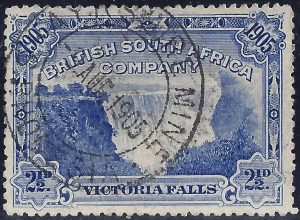
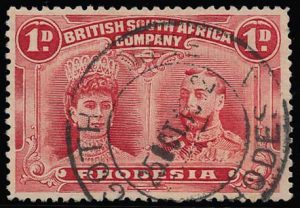
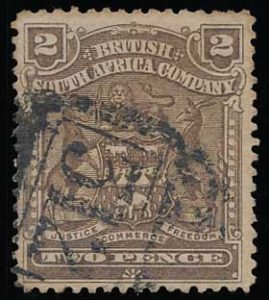
British South Africa Company: Department of Postmaster General – Postal Notice No.66 of 1898

Department of Postmaster General

Postal Notice No.66 of 1898

Mail Communication with Northern Zambesi

It is hereby notified for general information that a monthly mail service by native runners has been established between Bulawayo and Lialui in Barotseland. The mails leave Bulawayo and Lialui on the 1st of each month, and are conveyed by the Gwaai to Wankies, thence along southern bank of the Zambesi to Sekutes, five miles above Victoria Falls, thence along northern bank to Sesheke, thence to Lialui, the journey occupying twenty-five to thirty days. Letters only are conveyed by these posts, and any newspapers, book packets, or parcels intended for the places served by these posts can only be sent forward by wagon as opportunity offers. The rates of postage are the same as other parts of Rhodesia.

G. H. Eyre, Postmaster-General

General Post Office, Salisbury

Details

  • Date: 8 March 1898
  • Notice: 66/1898

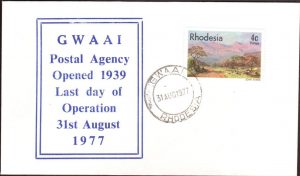
Gwaai

Gwaai

Nyamandhlovu District


Gwaai is a village that takes its name from the river Gwaai, whose name means “tobacco” in Ndebele.

This village, located on the national road from Bulawayo to Victoria Falls, was once the centre of a cattle-breeding area. It is now located in the heart of hunting areas and private safaris areas .

Post Office

History
  • 1907.02.18 – Post Office opened.
  • 1939.00.00 – Opened as Postal Agency.
  • 1940.00.00 – Name change to Gwaai Siding.
  • 1949.04.27 – Name reverted to Gwaai.
  • 1977.08.77 – Last day of operation.
Service
  • Mail service by rail.

Postmarks


TypeEarliest DateLatest DateNotes
D105/05/190703/02/1908
D225/05/190804/07/1916
D517/05/194915/02/1960
D631/10/196010/11/1965

Ayrshire Mine

Ayrshire Mine

Lomagundi District

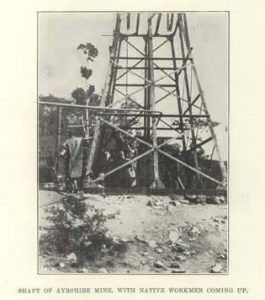
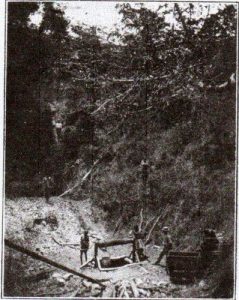
Towards the end of the 19th Century, globalization, opened by finance capital frequently turned on mining speculation. A particularly notorious case was that of the Ayrshire mine in Southern Rhodesia’s Lomagundi district. Touted in its heyday as the richest gold prospect in the entire southern half of the continent, the Ayrshire’s corporate existence was characterised by company-mongering and market manipulation in the City of London. Few of these concerns immediately impinged on indigenous interests.

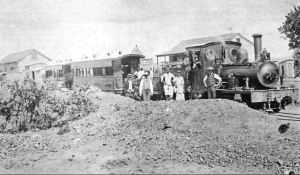
Gold claims were registered on 8 May 1893 on extensive ancient workings, on the Maquadzi River. By 1901 it was acquired by the Ayshire Gold Mine & Lomagundi Railway Company. The new owners contracted Pauling & Company to build a 2ft guage railway line from Salisbury to the mine, and this was complete in 1902 (using material and equipment from the Beira Railway).  In 1903, Ayrshire was the terminus on the postal runner route from Salisbury to Sipolilo and onwards to Feira and Fort Jameson. Two runners were employed at Ayrshire.

By 1906, this railway line had been taken over by the Mashonaland Railway Company. 1906, the gold bearing reef began petering out. By 1909 the mine and crushing mill had closed down and the once thriving community became a ghost town and in 1911 the Ayrshire section of the rail was discontinued.

Post Office

The Post Office agency was situated in the end room of the line at a hotel occupied by men working at the mine. It is suggested the agency closed when the Post Office could no longer justify the expense. It may have been due the Mashona Rebellion when the mine was abandoned.

Initially, mail was sent by runner. However, in 1902, mail was sent by rail to Salisbury.

  • 1895.00.00 – Date stamp issued but no evidence exists that it was used.
  • 1900.10.04 – Opened as Telegraph Office
  • 1901.01.01 – Opened as Railway Telegraph Office
  • 1902.11.20 – Regraded to Post Office
  • 1903.03.31 – Regraded as Railway Sub Office
  • 1903.07.01 – Regraded to Money & Telegraph Office
  • 1905.10.12 – Regraded to Post, Telegraph and Money Order Office
  • 1909.12.31 – Closed

Postmarks

Reference

FB

Gothic Mine

Gothic Mine

Lower Gwelo District


Gothic Mine is named after Gothic Farm about half a mile from the west bank of Gwelo river. The mine was first pegged in 1898 by the Consolidated Exploration and Development (Rhodesia) Co. A period of development followed and by 1902 it was decided that sufficient work had to amalgamate with the adjoining Pagamesa Claims.

Milling ceased at Gothic Mine in 1910 and a development option was taken on the property by Mashonaland Agency Ltd.

Around 1978/79 the mine was reopened by a South African industrial development corporation.

Postal Services

Mail service was by runner to Gwelo via Shamrock Mine.

  • 1912.08.22 – Postal Agency opened.
  • 1931.05.22 – Closed.

Postmarks

Reference

FB

Killarney Mine

Killarney Mine


Date: 15.05.1904 – 08.07.1910)

Type:

Service:

  • Coach to Filabusi
  • Runner (01.05.1910)

Postmark

TypeStart DateEnd DateNotes
D222.03.190608.07.1910

Reference

Joker Mine

Joker Mine


Date: 18.02.1907 – 04.05.1910

Type: Postal agency under Salisbury.

Service:

  • Runner to Salisbury
  • Runner to Kimbereley Reefs (15.11.1908)

Postmarks


TypeStart DateEnd DateNotes
D226.08.190931.03.1910

Reference

Iron Mine Hill

Iron Mine Hill

Gwelo District – Rhodesia/Southern Rhodeia


There were two post offices called Iron Mine Hill. One office was located at the mine run adjacent to where the miners smelted ore, and the second was at a railway siding, run by a storekeeper Mr J Picken (later turned farmer). The two post offices were approximately 3.5 miles apart.

Date: 29.07.1894 – 05.05.1950

Type:

  • Inauguration of mail service from Iron Mine Hill to Fort Victoria by Herman Bezuidenhout.
  • Post Office (1897/8) at the old settlement.
  • Post and telegraph office under Mazoe.

Service:

  • Coach by H B Bezuidenhout to Fort Victoria (29.07.1894)
  • Rail to Umvuma (19.06.1913)

Notes:

  • Iron Hill Mine closed (1912)
  • Iron Mine Hill Siding opened (1913)
  • Closed (01.08.1919 – 01.11.1919)

Postmarks

TypeStart DateEnd DateNotes
K101.03.189601.01.1898Iron Hill Mine
D201.03.189612.12.1898Iron Hill Mine
D200.00.189900.00.1899Missing day/month
D231.03.189520.03.189620mm. Possibly from the telegraph office.
D413.12.191305.05.1950Iron Hill Mine Siding
D402.02.192631.03.1926Blue ink.

Reference

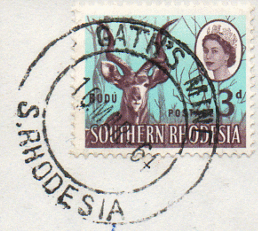
Gath’s Mine

Gath’s Mine

Victoria District


The claims for Gath’s Mine was originally pegged by J W Gath 28 June 1907 and were the first pegging for asbestos in the Mashaba area. Between 1907 and 1908, the ownership moved between:

From as early as 1908, workers were allocated accommodation according to race, rank and skill in housing complexes in high(Chemberi) and low(Gath’s) density residential areas.

Gath’s Mine as it is now collectively known as is a combination of three mines: King Mine and the now-defunct Temeraire and Gaths. The mining operations have stopped though some of the major buildings are located here such as the General Office – Administration, the hospital, the training centre and the high(Chemberi) and low(Gath’s) density residential areas for the workers.

However the area is now occupied by Great Zimbabwe University and the so-called General Office is now the Administration Block of the University. Most houses which were built for the miners were taken by the renovated and became Students Residence. Mining has been shattered down due to lack of funds and materials for mining to progress.

Postal Services

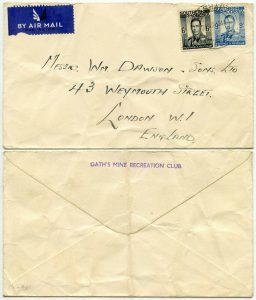
Gath’s Mine was a postal agency under Mashaba.

  • 1949.05.01 – Opened as a Post and Telegraph Agency.
  • 1975.07.31 – Closed.

Postmarks

References

FB

1 16 17 18 19