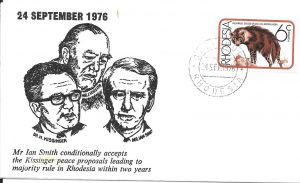
1976 – Smith Accepts Peace Proposal
Smith Accepts Peace Proposal
24 September 1976

The United States Secretary of State, Henry Kissinger, announced a formal interest in the Rhodesian situation in February 1976, and spent the rest of the year holding discussions with the British, South African and Frontline governments to produce a mutually satisfactory proposal.
The plan that Kissinger eventually presented would give a transition period of two years before majority rule began, during which time an interim government would take control while a specially convened “council of state”, made up of three whites, three blacks and a white chairman, drew up a new constitution. This constitution would have to result in majority rule at the end of the two-year interim period. This plan was supported by Kenneth Kaunda and Julius Nyerere, the presidents of Zambia and Tanzania respectively, which South African Prime Minister B. J. Vorster said guaranteed its acceptance by the black nationalists. Vorster had no reply when Smith ventured that he had said the same thing before the Victoria Falls talks in 1975, when Kaunda and Nyerere had agreed on no preconditions for talks, then allowed the nationalists to seek them.
Smith met Kissinger in Pretoria on 18 September 1976 to discuss the terms. He encouraged Smith strongly to accept the deal he placed on the table, though he knew it was unpalatable, as any future offer could only be worse.
A session including Kissinger, Smith and Vorster then began, and here Smith relayed his concern that his acceptance could be perceived by the Rhodesian electorate as “selling out” and could cause a mass exodus of skilled workers and investment, which would in turn severely damage the country’s economy.
Vorster requested a break in the session and took Smith’s team into a private side-room, accompanied by South African Foreign Minister Hilgard Muller. There he privately informed Smith that it was no longer viable for South Africa to support Rhodesia financially and militarily, and that Smith should make up his mind quickly and announce his acceptance that evening.
It was agreed that the Rhodesians should return to Salisbury and consult their cabinet, then announce their answer. Despite expressing “incredulity” at what had happened in Pretoria, and showing deep reluctance, the politicians in Salisbury resolved that despite what they perceived as “South African treachery” the responsible course of action could only be to go on with the peace process.
Smith announced his government’s answer on the evening of 24 September 1976: “Yes.” South Africa’s wavering financial and military assistance suddenly became available again but the Frontline States then abruptly changed tact and turned the Kissinger terms down, saying that any interim period before majority rule was unacceptable.
A new constitutional conference in Geneva, Switzerland was hastily organised by Britain to try to salvage something from the wreckage, with 20 October 1976 set as the start date.