
Marshall Hole Currency Cards
Marshall Hole Currency Cards
British South Africa Company
At the outbreak of the Boer War in 1899, the Boers captured the railway link between Kimberley and Bulawayo when they surrounded Vryburg and Mafeking. The railway fed supplies and mail from the Cape Colony to Rhodesia. As supplies became scare, so did gold and silver coinage. The lack of coinage threatened to strip farms and mines of African labourers, whose wages had to be paid regularly.

Hugh Marshall Hole, serving as Government Secretary to Matabeleland and Civil Commissioner of Bulawayo, suggested the use of stamps (of which they had a large supply) attached to cards bearing an order on the fiscal officer (Civil Commissioner) to pay the value of the stamps if presented after 1st August, 1900. The administration was confident that the railway would resume at this time.

The Administrator, Arthur Lawley, agreed to the cards on the condition that they bear the Civil Commissioner’s signature. A metal die was prepared for Marshall Hole and the Standard Bank agreed to treat the cards as cash.
It was believed that the Africans hoarded silver but not copper, so the lowest value to be produced was 3d (which was the smallest silver coinage available). Approximately £20,000 worth of cards were issued in the values of 3d, 6d, 1/-, 2/-. 2/6d and 10/-.
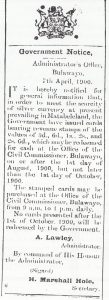
The currency tension was eased with the relief of Mafeking on May 16th, 1900. £19,000 worth of cards were redeemed by October, 1900 when the cards were removed from circulation.
Types
- Type I – Administrator’s Office
- Type II – Administrator’s Office, Bulawayo
- Type III – Administrator’s Office
- Type IV – Administrator’s Office, Bulawayo
Reference
- The Philatelic & Postal History Treasures of the National Archives of Zimbabwe
- The Journal of the Rhodesian Study Circle No.9
- The Journal of the Rhodesian Study Circle No.10
- The Journal of the Rhodesian Study Circle No.100
- The Journal of the Rhodesian Study Circle No.207
- The Journal of the Rhodesian Study Circle No.216