Methodist Episcopal Church: Old Umtali Mission – Theological School

Old Umtali Mission

Theological School


A Theological School was begun at Old Umtali Mission in 1927 to train African pastors. Initially it was a department of the Hartzell Training School under the supervision of Reverend M. J. Murphree. As of 1931, five of the seven students were ready to complete the three-year course. Class work was augmented by practical experience gained in “camp-meetings” that were being held. A. L. Mansure was in charge of the school as of 1951, assisted by his wife, Reverend E. J. Asechliman (who later became Director of the school) and J. M. Chimbadzwa. A notable alumnus of the school during that time was Bishop Abel Muzorewa, who was briefly Prime Minister of Rhodesia, 1979-1980.

As of 1953, the school was known as “Old Umtali Theological Seminary” (also referred to as the Hartzell Theological Seminary). Dr. Maurice E. Culver was a teacher and Principal, 1953-1957. Beginning 1958, the school became known as “Old Umtali Biblical Institute.” Dr. Culver continued as Principal of the institute until 1961. He was succeeded by Reverend Hunter D. Griffen. Other faculty included Henry I. James and Mr. and Mrs. A. Reid. There were no approved candidates in 1965 and existing students were transferred to Epworth Theological College in Salisbury (Harare). The school was closed sometime thereafter.

Reference

  • Journals of the Methodists Rhodesia Annual Conference
Contributors
  • Mark Loomis

FB

Robert C Gates

Robert C Gates

1892-1964

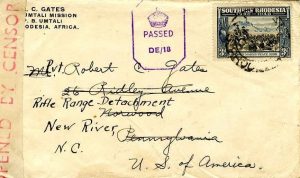
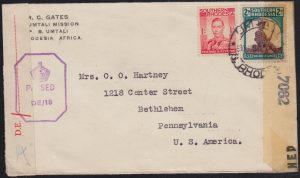
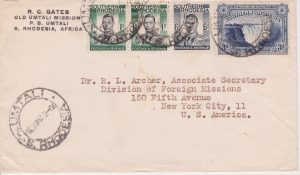
Robert C. (R. C.) Gates was born November 1892 in Renova, Pennsylvania to William and Gertrude (Rhoads) Gates. He graduated from Dickinson College in 1915 and married his wife, Mildred Colcord. The Gates came to Southern Rhodesia in 1922 as part of the Methodist Episcopal Church’s Rhodesia Mission Conference. He was ordained a deacon in 1923.

During his first ten years of missionary service in Southern Rhodesia, Reverend Gates was at Old Umtali Mission serving as pastor, superintendent, and Principal of the Hartzell Training School. In the following years, he served as superintendent of the Nyadiri Mission, and Mrewa Mission, Umtali-Rusape and Marange Districts. He was also the mission and Conference Treasurer and pastor of St. Andrews Church in Umtali (Mutare). Mrs. Gates supervised women’s work in the various districts in which they were stationed.

After forty-one years of missionary service, the Gates retired in 1963 and returned to Pennsylvania where Rev. Gates was granted an honorary Doctor of Divinity by Dickson College. He died in October 1964. His wife, Mildred, died in April 1970.

References

Contributor
  • Mark Loomis

FB

Churches of Christ: Namwianga Mission

Churches of Christ

Namwianga Mission

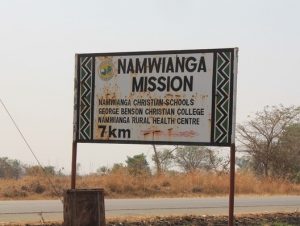
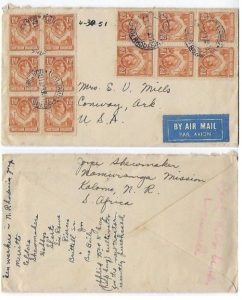
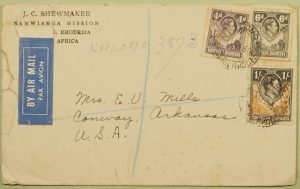
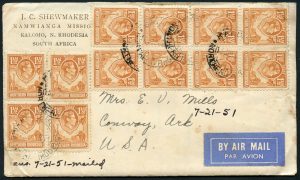
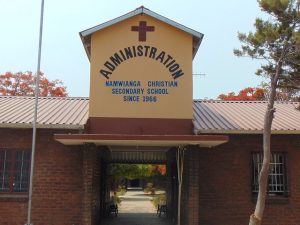
Namwianga Mission was founded near Kaloma, Northern Rhodesia (Zambia) by Churches of Christ missionaries Dow and Helen (Alice) Merritt in 1932 (the Merritt’s first arrived in 1926). Encompassing 6,000 acres, the mission originally consisted of three separate farms that were consolidated during the 1940s and 1950s.

The mission began primary schools in the 1930s to promote the Christian faith and to teach students to read the Bible. In the 1960s, Dr. George Benson, along with Dow Merritt, raised enough money to build a high school, currently the Namwianga Christian Secondary School. In the early 1990s, Namwianga Mission partnered with the University of Zambia to establish George Benson Christian College (named in Dr. Benson’s honor), which is a three-year college that trains students to teach at the secondary level.

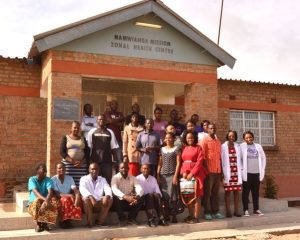
Other facilities include the Namwianga Mission Hospital (formerly Namwianga Zonal Health Center) treating more than 10,000 patients per year, farm, radio station, and “The Haven” in-home orphan care. The orphanage operates four homes that support infants, toddlers, children with special needs and the fourth home, named “Eric’s House, for older boys.

In addition to the Merritt’s, early missionaries at Namwianga include Mrs. Ray Lawyer, Mr. and Mrs. J. C. Shewmaker, Mr. and Mrs. Alvin Hobby, Myrtle Rowe, and Alva and Margaret Rees. Dow Merritt’s son, Roy, together with his wife Kathi, returned to Namwianga Mission sometime in 1968-69 to teach at the high school and have continued to serve at the mission over many years.

Namwianga Mission is currently operated by Zambia Christian College, which goes by the name Zambia Mission Fund. The mission has been supported as a “permanently funded work” of the Prescott Church of Christ church in Texas, since 2006.

Facilities

  • George Benson Christian College
  • Namwianga Christian Secondary School
  • Namwianga Mission Hospital
  • The Haven In-Home Orphan Care

References

Contributors
  • Mark Loomis

FB

Churches of Christ: Central Africa Mission Evangelistic Literature Service

Churches of Christ

Central Africa Mission Evangelistic Literature Service

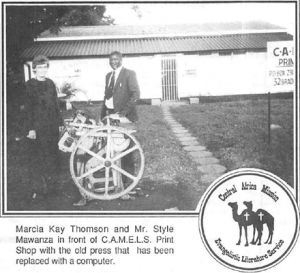
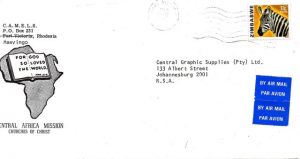
Begun in 1965, the Central African Mission Evangelistic Literature Service (CAMELS) is Churches in Christ mission publishing house located in Masvingo, Zimbabwe. CAMELS supports the education efforts of both Zimbabwe Christian College and the greater evangelical efforts in southern Africa by publishing songbooks, lesson materials, religious tracts, baptismal certificates and other printed materials. It also supports itself by doing commercial printing for mission institutions and various church groups.

For a number of years, the publishing house was overseen by Frances Johnson. Marcia Kay Thompson was manager of CAMELS as of 1993.

Reference

Contributors
  • Mark Loomis

FB

Evangelical Lutheran Church in Zimbabwe

Evangelical Lutheran Church in Zimbabwe


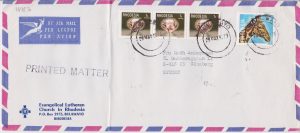
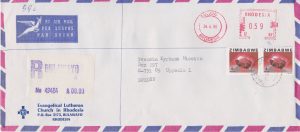
The Church of Sweden became an independent church in 1963 as the Evangelical Lutheran Church now known as the Evangelical Lutheran Church in Zimbabwe (ELCZ).  As such, it took over administration of all work (including the missions) previously directed by CSM. Jonas Shiri was consecrated as the first African bishop in 1975.

The “struggle for liberation” in the late 1970’s seriously impacted ELCZ schools, causing many to close (some were destroyed).  All Swedish missionaries were withdrawn by the Church of Sweden in 1976.  The schools were re-opened post independence in 1980.  As of 2006, ELCZ had 134,000 members, the vast majority of which are in the southern part of the country. The church runs a number of schools, four hospitals and a nursing school.

References

Contributors
  • Mark Loomis

FB

Roman Catholic Church: Archdiocese of Lusaka

Roman Catholic Church

Archdiocese of Lusaka

The Vicariate Apostolic of Lusaka was elevated to an archdiocese on 25 April 1959. The first Archbishop was Adam Kozłowiecki (1911-2007) of the Society of Jesus.

References

FB

Diocese of Hwange: Holy Family Parish

Diocese of Hwange

Holy Family Parish


In 1936, St Mary’s Lukozhe was moved to establish St. Mary’s Mission. From St. Mary’s the Mariannhill missionaries visited regularly Hwange where the school of St. Ignatius and the parish were more effectively served.

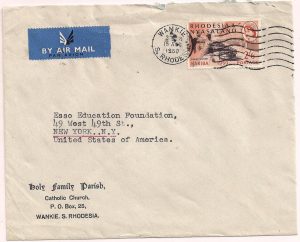
The earliest details of the parish of the Holy Family go back to 1938. However, it appears to formally exist from 1951. The Holy Family Parish was one of four urban parishes in Wankie.

References

FB

Roman Catholic Church: Diocese of Hwange

Roman Catholic Church

Diocese of Hwange

The Prefecture of Wankie was cut off from the Apostolic Vicariate of Salisbury and Apostolic Vicariate Bulawayo and was erected on 29 June 1953 and confided to the Fathers of the Spanish Mission Institute (SMI). On 1 March 1963, the Prefecture of Hwange became a Diocese.

On 3 July 1991, the civil district of Gokwe, the area of Omay between the Sengwa and Sanyati rivers in the Kariba district, and the area of the Nkayi district north of the Shangani river, were cut from the Diocese of Hwange and formed into the Diocese of Gokwe.

The Diocese of Hwange comprises the following civil districts: Hwange, Binga, and the part of Lupane north of the Shabula River. It is bounded on the North by Zambezi River, on the West by Botswana, on the East by the civil districts of Omay, Gokwe, Lupane and on the South by Nyamandlovu.

Parish

  • Holy Family
  • Our Lady of Peace
  • Ss Peter and Paul
  • St Charles Lwanga
  • St Francis Xavier
  • St George
  • St Joachim
  • St Joseph
  • St Josephine Bakhita
  • St Kizito
  • St Monica
  • St Teresa

Missions

  • All Souls
  • Holy Cross
  • Mary Inmaculate
  • Our Lady of Fatima
  • Sacred Heart
  • St John the Baptist (Dandanda)
  • St John the Baptist (Makwa)
  • St John Vianney
  • St Martin de Porres
  • St Mary’s
  • St Teresa of the Child Jesus

References

Dutch Reformed Church: Margaretha Hugo School for the Blind

Dutch Reformed Church

Margaretha Hugo School for the Blind

The Margaretha Hugo School for the Blind (commonly known as Copata School for the Blind) had its origins when the parents of a blind boy approached Dutch Reformed Church missionary Reverend Hugo at Chibi Mission for help. Rev. Hugo asked his wife, Margaretha, to look after the boy and she replied “I will try,” from which was born the later motto of the Margaretha Hugo Mission – “We will try.”Soon, there were 8 children in her care. Margaretha later went to South Africa to learn how to teach Braille.

Established in 1915, the school was registered as a school in 1927 as the first school in Southern Rhodesia providing services to students with disabilities. Because of challenges with accessibility, the school was moved to the Zimuto Mission farm in 1938.

From its initial founding, the school has grown to include a primary and secondary boarding school supporting 480 students with disabilities, most of them with visual impairments, coming from across Southern Africa. The school has a staff of 35 primary and 14 secondary school teachers and continues to be managed by the Reformed Church in Zimbabwe (RCZ).

References

Contributors
  • Mark Loomis

Dutch Reformed Church: Zimuto Mission

Dutch Reformed Church

Zimuto Mission

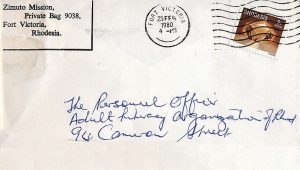
African evangelist from the Dutch Reformed Church (DRC) first entered the area of what would become Zimuto Mission in the 1870-80’s, but it was the Berlin Missionary Society (BMS) that opened Zimuto Mission in 1904, 15-20 km north of Fort Victoria (Masvingo). BMS transferred control of Zimuto to the DRC in 1907.

The first DRC missionary, Rev. G. S. Murray, was sent to the mission in 1907 and did a lot of evangelism in the area. Educational and medical work was started soon after the mission opened. In 1956 a secondary school was opened with the aim of offering preparatory training for entering the Higher Primary Teacher Training Course, an advanced nursing course, or a course for African ministers. The Margaretha Hugo School for the Blind (Copata) was moved from Chivi to the Zimuto Mission farm in 1938 as a sister institution.

Along with DRC’s other missions in Southern Rhodesia, Zimuto Mission was transferred to the local control of the African Reformed Church – later renamed Reformed Church in Zimbabwe (RCZ) – in 1977.

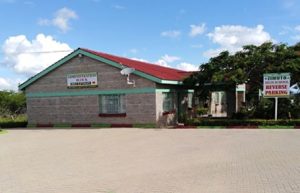
Today Zimuto is also one of the RCZ’ s largest mission stations. It has a conventional primary school, a primary school for the blind, a high school, a secondary school for the blind, a clinic and workshops for basketry and chalk making. Zimuto High School has students from Form 1 through “A” level and more than 50 teaching staff. Zimuto Clinic has 6 beds and serves the majority of the people in the Zimuto area. It averages 6 deliveries a month.

References

Contributors
  • Mark Loomis

FB

1 2 3 4 5 73