Nyasaland Electricity Supply Commission

Nyasaland Electricity Supply Commission

Blantyre

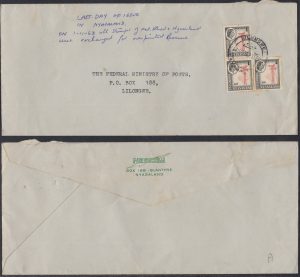
In 1958, the Nyasaland Government enacted the Electricity Act. Under the new act the Nyasaland Electricity Supply Commission (NESCOM) took over the assets, liabilities and staff of the Electricity Services Department (which had been established in 1948 within the Ministry of Public Works).

NESCOM became the sole agency to generate, transmit and distribute electricity in Nyasaland and were granted regulatory powers. It was a statutory corporation
which was self-regulating.

In 1963, the new Malawi government revised the Electricity Act, 1958 to ESCOM Act, 1963 and the name of NESCOM was changed to the Electricity Supply Commission of Malawi (ESCOM).

References

Contributor
  • James Gavin

O. Conolly & Company (PVT) Ltd.

O. Conolly & Company (PVT) Ltd.

Bulawayo

O. Conolly & Co was founded in 1929 by Mr Osment Conolly with an initial capital of $200. At first the foundry consisted of a small cupola furnace, built by Mr. O. Conolly and housed in a shed on Industrial Stand No. 1 in Bulawayo. The first products were mine-stamp batteries to mill ore at small gold mines, but as demand for Conolly equipment grew, a machine shop was started to increase the range and quantity of products manufactured.

Today, more than 80 years later, the company has two sites offering a facility that continues to service Zimbabwe and southern Africa with quality products. Facilities include a large foundry, machining, CNC and fabrication. Many Conolly cranes can be seen throughout Zimbabwe.

References

Contributors
  • James Gavin

Gallo Africa Ltd

Gallo Africa Ltd

Bulawayo


The company was originally created by Eric Gallo in 1926 as a one-man business, the Brunswick Gramophone House. The record shop was originally devised to distribute records from the US-based Brunswick Records into South Africa. However, noticing the lack of recording facilities (as well as the amount of local talent) in the country, Gallo decided to form a recording studio in 1932 and, borrowing equipment (and a sound engineer) from the then just-defunct Metropole company in the United Kingdom, Gallo opened the “Gallo Recording Studios” under the auspices of Gallo Africa (using a red rooster as the company’s symbol, which remains today).

The business eventually opened the first recording studio in Southern Rhodesia in Bulawayo. Gallo Pty Ltd became a public company in 1946 and became known as Gallo Africa Ltd.

The Gallo Record Company is the largest (and oldest independent) record label in South Africa. It is based in Johannesburg, South Africa, and is owned by Times Media Group (formerly Johnnic Communications and Avusa).

References

  • Sound of Africa!: Making Music Zulu in a South African Studio – Louise Meintjes
Contributors
  • James Gavin
  • Sean Burke

FB

Beaverdam Farm

Beaverdam Farm

Umtali

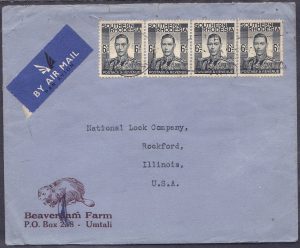
Beaverdam Farm was owned by Barnaby J. Howard, son of a British lord, who grew up to be a pilot with the U.S. Navy during World War II and later a farmer in Southern Rhodesia.

He established a ranch near the town of Umtali. Though it was in rough bush and the haunt of baboons and leopards, he built a house with the mud of the land, put in a water supply and a road.

In addition to raising a family, running his cattle ranch, cultivating tobacco, and running a small medical clinic, he was appointed to the Commission on Forestry and Conservation, while beginning a multitude of business ventures. By the early 60’s the political situation had deteriorated in Rhodesia and he became disenchanted with the government. Amidst political turmoil, he left in 1965.

References

Contributors
  • James Gavin

African Commercial Co.

African Commercial Co.

Salisbury

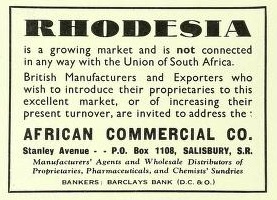
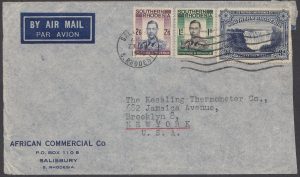
The African Commercial Co. was a Manufacturer’s Agent and Wholesale Distributor of ‘proprieties, pharmaceuticals, and Chemist Sundries’.

References

  • The Druggist and Chemist, 1937
Contributors
  • James Gavin

FB

Mindolo Ecumenical Foundation

Mindolo Ecumenical Foundation

Kitwe

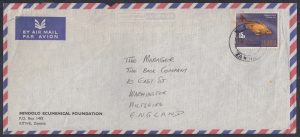
The Mindolo Ecumenical Foundation (MEF) was founded in 1958 and formally established in 1959. From its very beginning MEF was established as an ecumenical institution with the aim of serving the Church and community at large in deepening their understanding of the crucial issues facing them and affecting the unity and renewal of the Church.

In practical terms, MEF sought to prepare Africans from the Copperbelt province of Zambia and other countries in trade unionism, community development, modern farming, Christian ethics, and political science and many more, all within the Christian re-conciliatory approach.

Over time, MEF sought to prepare Christians to participate in Industry and Commerce as an added priority through provision of education that encourages development of life skills that would get the graduates out of the poverty trap. However, training in various fields was and remains the main business of MEF.

The burning issues started to change in the 1990’s and the 2000’s when the priorities had to include responding to the reality of HIV and AIDS, quest for multi-party politics, gender based violence and other challenges affecting the society.

Questions were raised as to whether the original mandate of MEF was still relevant at the beginning of the 21st century. However, a number of new courses and programs were introduced to respond to changing society needs. These include specialized care for orphans and vulnerable children (OVC), social work, community development and women training programs.

Services

  • African Literature Centre
  • Young Women’s Christian Association
  • United Church of Zambia Theological College
  • Theological Education by extension in Zambia
  • St. John’s Anglican Seminary.

References

Contributor
  • James Gavin

FB

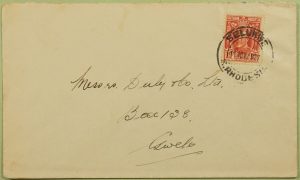
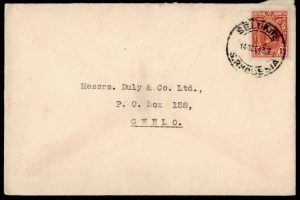
Duly & Co Ltd: Gwelo

Duly & Co Ltd

Gwelo

Kachere Rehabilitation Centre

Kachere Rehabilitation Centre

Blantyre

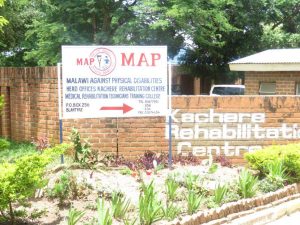
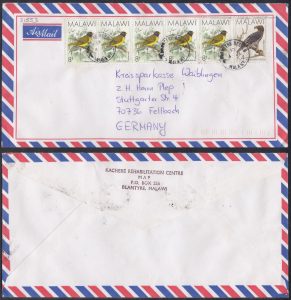
Kachere Rehabilitation Centre is part of the Malawian non-Government organisation called Malawi Against Physical Disabilities (MAP). MAP was already running outreach rehabilitative services by the early 1980’s reaching both the urban and rural communities throughout Malawi.  As the organisation carried out these services, in the mid 80’s they realized that some clients needed intensive rehabilitation, and that just the monthly visits they were making to each place were not sufficient for those with acute rehabilitation needs.

This is when the idea of building a rehabilitation centre came in. Various individuals, local companies and international organisations were approached to assist with the construction of the Centre’s funding. Among the international organizations that were approached with constructing the Centre were Christoffel Blindenmission the European Community, Christoffelblinden Mission and the Beit Trust.

Construction of the Centre took approximately two years, and in August 1992 the Centre was completed and was ready to start its operations.  Unfortunately Christoffel Blinden mission who offered to provide  the initial staffing took time to identify the staff until 1994. In 1994 therefore Christoffel blindenmission took up the full financing of the Centre. Until 1998 when they phased out.

Kachere Rehabilitation Centre is Malawi’s only medical facility designed to provide intensive medical rehabilitation to people who have met with a disabling condition such as stroke, road traffic accident, industrial accident, tumours and disease.The Centre is situated along Chipatala Avenue opposite the country’s main referral hospital, Queen Elizabeth Central Hospital, in the commercial city of Blantyre.

Since the target group of the Centre is the poor, all rehabilitation and nursing services are provided at no cost to all admitted patients.  Food is also provided at no cost to 90% of the patients.  However, there are a few patients who can afford to pay for their meals and other private room facilities; these are asked to pay an appropriate fee.  These make up only 10% of the clients.

Reference

Contributors
  • James Gavin

The Institute of Cultural Affairs: Zimbabwe

The Institute of Cultural Affairs

Zimbabwe


ICA Zimbabwe, established in 2001, has been providing training and project leadership to the nation, its government and non-government sectors. It is autonomous but affiliated with the Institute of Cultural Affairs International (ICAI) and its associates in 40 nations.

Through that affiliation, research in methods is shared, assistance with fund raising is provided and high-level authorization is developed. In the latter case, an example is ICAI’s consultative status with the Economic and Social Council of the United Nations since 1985.

The Institute of Cultural Affairs

The Institute of Cultural Affairs


The Institute of Cultural Affairs (ICA) is a global community of non-profit organisations advancing human development worldwide. It aims to act as a catalyst for people in a variety of contexts and circumstances to take active responsibility for their own personal, community and societal development.

The organisation is explicitly secular and international since it was first separately incorporated in the 1973.

Regions

References

Contributors
  • James Gavin
1 28 29 30 31 32 51