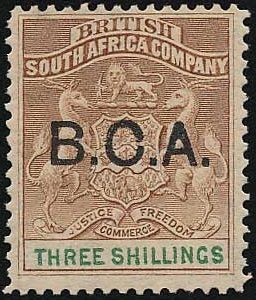
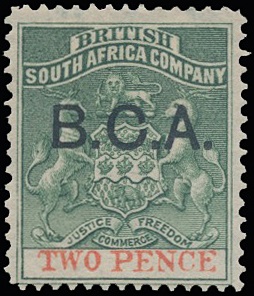
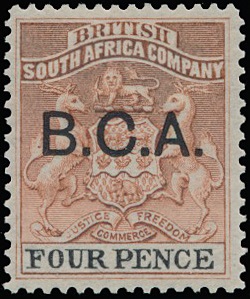
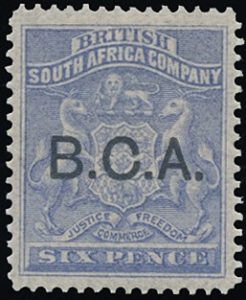
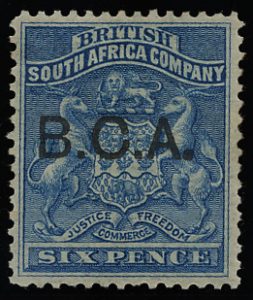
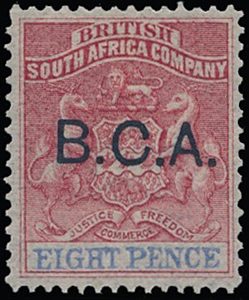
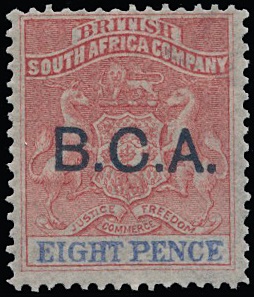
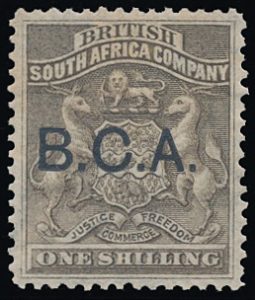
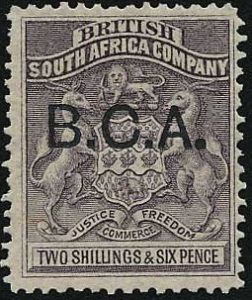
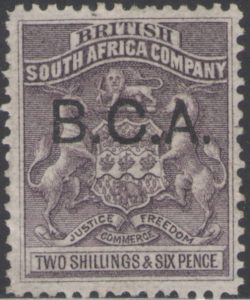
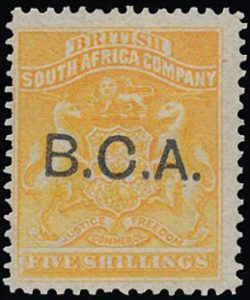
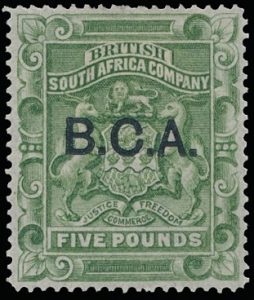
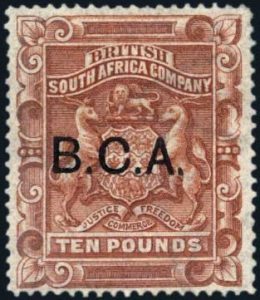
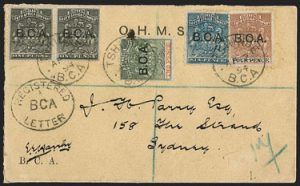
1895 – B.S.A.C. Overprints (3/- Value)

British Central Africa

1895 – B.S.A.C. Overprints (4/- Value)

Details

  • Date of Issue: 1895
  • Date Withdrawn:
  • Date Invalidated:
  • Designer: 
  • Printer: Bradbury Wilkinson
  • Process: Recess
  • Paper: Thin wove paper
  • Watermark: 
  • Perf: 14, 14.5
  • Cylinders: N/A
  • Sheet:
  • Booklet: N/A
  • Quantity:

FB

1893 – B.S.A.C. Overprints (4/- Value)

British Central Africa

1893 – B.S.A.C. Overprints (4/- Value)

Details

  • Date of Issue: February, 1893
  • Date Withdrawn:
  • Date Invalidated:
  • Designer: 
  • Printer: Bradbury Wilkinson
  • Process: Recess
  • Paper: Thin wove paper
  • Watermark: 
  • Perf: 14, 14.5
  • Cylinders: N/A
  • Sheet:
  • Booklet: N/A
  • Quantity:

FB

1891 – B.S.A.C. Overprints

British Central Africa

1891 – B.S.A.C. Overprints

Details

  • Date of Issue: 20th July, 1891
  • Date Withdrawn:
  • Date Invalidated:
  • Designer: 
  • Printer: Bradbury Wilkinson
  • Process: Recess
  • Paper: Thin wove paper
  • Watermark: 
  • Perf: 14, 14.5
  • Cylinders: N/A
  • Sheet:
  • Booklet: N/A
  • Quantity:

FB

Blantyre Printing & Publishing Co Ltd

Blantyre Printing & Publishing Co Ltd

Blantyre


The Blantyre Printing & Publishing Co Ltd was originally established in 1895, largely through the efforts of R S Hynde, a Scotsman with teaching experience at Domasi, Zomba. The company shared printing with the Blantyre Mission Press.

The company closed in 1907 but was resurrected after independence in 1964 to become a sophisticated printing and publishing company with subsidiary companies such as Times Bookshop Ltd and Blantyre Periodicals Ltd.

The business is now known as Blantyre Printing and Packaging Co Ltd.

Postcards

References

  • The Society of Malawi Journal Vol 31 No.2, July 1978

Recent Updates

Since December, 2015, the Rhodesian Study Circle has transitioned itself from an established philatelic society to one catered for the 21st Century collector. With thousands of images and over 5,500 pages of philatelic items, we are combining philately with the colourful history of Central Africa to help support you in building your collections.

If you have any questions, comments, feedback or information, please Contact Us

August, 2026

The Index for the RSC Journal

  • The Index for the Journal (Topic or Author) – from 1948 to 2025 (Vols. 1-309) is now available on this website. (Updated December, 2025). This is an amazing resource for research! Our thanks to Geoff Brakspear. 

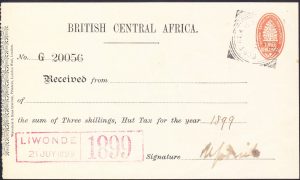
British Central Africa: Native Tax – 1899

British Central Africa

Native Tax – 1899

FB

British Central Africa

British Central Africa

British Central Africa was a protectorate proclaimed in 1889 and ratified in 1891 that occupied the same area as present-day Malawi.

British interest in the area arose from visits made by David Livingstone from 1858 onward during his exploration of the Zambezi area. This encouraged missionary activity starting in the 1860s, undertaken by the Universities’ Mission to Central Africa, the Church of Scotland and the Free Church of Scotland followed by a small number of settlers.

The Portuguese government attempted to claim much of this area, but their claims were disputed by the British government. To forestall a Portuguese expedition claiming effective occupation, a protectorate was proclaimed, first over the south of this area, then over the whole of it in 1889. After negotiations with the Portuguese and German governments on its boundaries, the protectorate was formally ratified by the British government in May, 1891.

The protectorate was renamed Nyasaland in 1907.

Taxes & Duties

Stationery

People

Contributors
  • Adrian de Bourbon
  • Peter Gorton

John Thomas Gosling

John Thomas Gosling


John Thomas Gosling became acting Postmaster General of British Central Africa on 29th July, 1897, succeeding Edward Alston on 28th September, 1898. He received his training from the Imperial Post Office.

Gosling was a specialist Postal Officer and helped speed up internal mails, partly by a system of nightly postal runners. By 1899, over 300 mail bags a month were being carried by the postal runners, covering 10,000 miles a month (with 3,000 miles conducted at night).

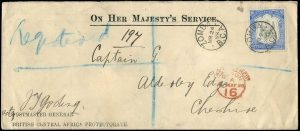
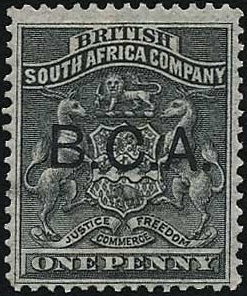
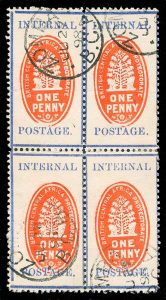
He also introduced a number of new postal services, opened up new post offices and introduced the first annual postal guide. In 1897 stocks of 1d stamps were near exhausted. Three shilling stamps were overprinted to assist. However, in 1898 Gosling designed and printed his own stamps known as ‘cheque stamps’.

He remained in office until 9th April, 1904 at which time he was transferred to East Africa and Uganda Protectorate.

References

  • The Society of Malawi Journal Vol. 24, No. 2 (July, 1971)
  • The Society of Malawi Journal Vol. 29, No. 2 (July, 1976)
  • East Africa (British) Its History, People, Commerce, Industries and Resources.
Contributors
  • Peter Gorton
1 2 3 4 5 6 11