Moshal, Gevisser & Partners Ltd

Moshal, Gevisser & Partners Ltd

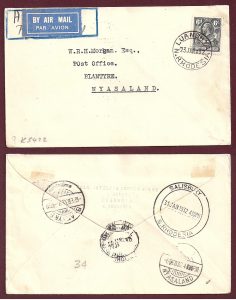
Livingstone
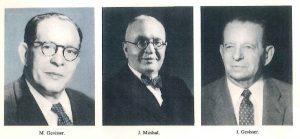
Moshal, Gevisser & Partners Ltd was originally established in 1910 as a partnership between J Moshal, I Gevisser and M Gevisser.

Moshal arrived in South Africa from Europe in 1898. By 1908 after trying many enterprises, he and his wife were running a small business selling second-hand bottles and bags. In 1910, they invited M and I Gevisser (who arrived in South Africa in 1904), to join the partnership to help with capital to grow the business.

J Moshal’s son joined the business in 1919 after World War I and by 1930 the business was known as Moshal Gevisser (Pvt) Ltd. However, by 1945 the company found the need for more provisions and became Moshal Gevisser Holdings Ltd with shares listed on the London and Johannesburg stock exchanges.

The company had three main activities. The first and major part was wholesale distribution of general merchandise, the second part was manufacturing, and the third part was administration.
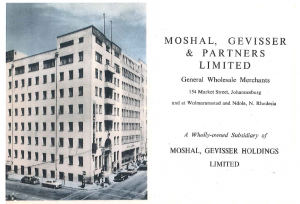
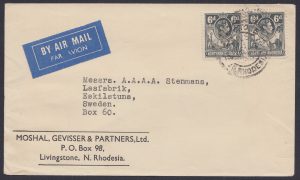
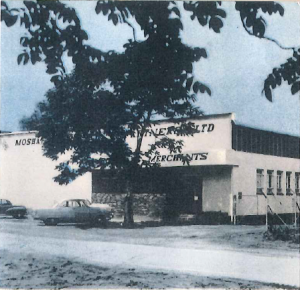
The wholesaler side of the business was known as Moshal, Gevisser & Partners Ltd. The Johannesburg company managed the branches in Ndola and Livingstone in Northern Rhodesia.
 

References

  • Moshal, Gevisser Ltd and Associated Companies 1910-1960
Contributor
  • James Gavin

FB

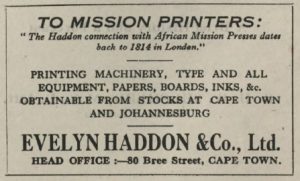
Evelyn Haddon & Co Ltd

Evelyn Haddon & Co Ltd

Salisbury

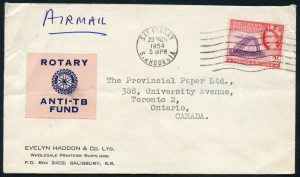
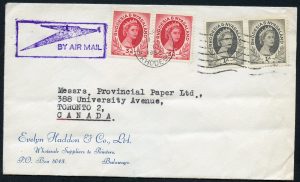
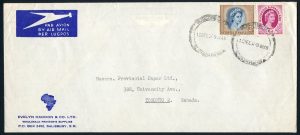
Evelyn Haddon & Co Ltd was established in South Africa in 1905 with bases at Johannesburg and Cape Town (although the origins go back to Britain). It was a printing and wholesale supply company.

Branches

  • Bulawayo
  • Salisbury
Contributors
  • Walter Herdzik

FB

David Ruxton Ltd

David Ruxton Ltd

Umtali

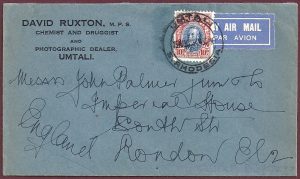
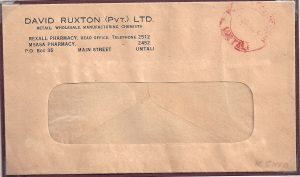
David Ruxton M.P.S. was born in 1885 in Montrose, Scotland. He owned a chemist, druggist and photographic store in Umtali.

He died 17 October 1935. His business continued after his death becoming a Rexall Pharmacy. It continues to trade today.

Contributors
  • Keith Harrop

FB

The Livingstone Motor Works Ltd

The Livingstone Motor Works Ltd

Livingstone

The Livingstone Motor Works Ltd was Livingstone’s first motor garage. It was established in 1919 by the Grill family.

Contributors
  • Keith Harrop

FB

Freemasons: Grand Lodge

Freemasons

Grand Lodge

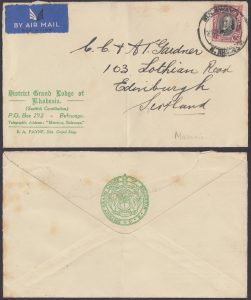
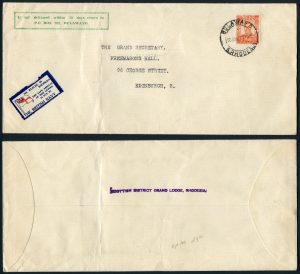
A Masonic “Grand Lodge” (also “Grand Orient”) is the governing body that supervises and governs the individual “Lodges” of Freemasons in any particular geographical area or “jurisdiction”, (usually corresponding to a national boundary or other major political unit). Some are large, with thousands of members divided into hundreds of subordinate Lodges. Others are tiny, with only a few members in one or two subordinate Lodges.

Sometimes there will be only one Grand Lodge in a given area. More often, however, there will be several competing Grand Lodges claiming the same jurisdictional area, or claiming overlapping areas. This fact leads to debates over legitimacy: Not all Grand Lodges and Grand Orients recognise each other as being legitimate. However, such recognition is not relevant to this list. Inclusion criteria only establish a physical (as against an internet) presence, and lodges which meet as masons.

Contributors
  • James Gavin
  • Walter Herdzik

FB

I O Adam Ltd

I O Adam Ltd

Limbe

I O Adam Ltd was a cycle dealer and general merchant in Limbe. They were the sole distributor for Raleigh and Humbler cycles in Nyasaland.

Branches

  • Blantyre
  • Lilongwe
  • Limbe
  • Zomba
Contributors
  • Keith Harrop

FB

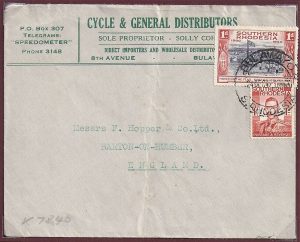
Cycle & General Distributors

Cycle & General Distributors

Bulawayo

Cycle & General Distributors was a direct importer and wholesale distributor. The business was owned by a Romanian Jewish man by the name of Sally Cohen (b.1886).

Cohen died 2 November 1961.

Contributors

  • Keith Harrop

FB

Freemasons: Supreme Grand Chapter of Royal Arch Masons

Freemasons

Chapters

The Supreme Grand Chapter of Royal Arch Masons is commonly referred to simply as ‘The Chapter’ and has an important place in the whole Masonic Structure.

Many Freemasons are quite happy to accept that the Hiramic legend ends on the steps of the Temple with the death of mortal man. Those who believe there is something more are invited to explore the Royal Arch and contemplate what lies beyond. The restoration of the Genuine Secrets has a significance which is believed to be the key to intellectual Freemasonry.

Where the allegories of the three degrees of the Craft lead masons to contemplate the mysteries and lessons of man’s activities of the physical plane-birth, life and death, the Royal Arch opens a whole new world to the thinking man – the contemplation of the spiritual plane, and the essential relationships between God and man.

For historical reasons, the Royal Arch is organised as a separate Order distinct from the Craft degrees to which it belongs and the teaching of which it completes. It follows that in deciding to join the Royal Arch brethren will have made a conscious decision to make significant advancement in Masonic knowledge. The prerequisite is simply for a Master Mason to have a thorough knowledge of the Craft degrees.

In England, the Royal Arch is considered to be the completion of “pure ancient Masonry”. In the Craft, the candidate is presented with a series of eminently practical principles and tenets which if he practises them he may hope to live a life pleasing to his God, however he worships him, and of service to his fellow man. In that sense, “pure ancient Masonry” can be seen as a journey of self-knowledge and discovery with the Royal Arch completing the practical lessons of the Craft by a contemplation of man’s spiritual nature, not replacing but reinforcing and supporting what he has learned from his religion.

References

Contributors
  • Keith Harrop

FB

Freemasons

Freemasons

Freemasonry or Masonry consists of fraternal organisations that trace their origins to the local fraternities of stonemasons, which from the end of the fourteenth century regulated the qualifications of stonemasons and their interaction with authorities and clients.

The degrees of Freemasonry retain the three grades of medieval craft guilds, those of Apprentice, Journeyman or fellow (now called Fellowcraft), and Master Mason. The candidate of these three degrees is progressively taught the meanings of the symbols of Freemasonry, and entrusted with grips, signs and words to signify to other members that he has been so initiated.

The initiations are part allegorical morality play and part lecture. The three degrees are offered by Craft (or Blue Lodge) Freemasonry. Members of these organisations are known as Freemasons or Masons. There are additional degrees, which vary with locality and jurisdiction, and are usually administered by their own bodies (separate from those who administer the craft degrees). Historian Jasper Ridley argues that it is, “the World’s Most Powerful Secret Society.”

The basic, local organisational unit of Freemasonry is the Lodge. The Lodges are usually supervised and governed at the regional level (usually coterminous with either a state, province, or national border) by a Grand Lodge or Grand Orient. There is no international, worldwide Grand Lodge that supervises all of Freemasonry; each Grand Lodge is independent, and they do not necessarily recognise each other as being legitimate.

Modern Freemasonry broadly consists of two main recognition groups. Regular Freemasonry insists that a volume of scripture is open in a working lodge, that every member profess belief in a Supreme Being, that no women are admitted (although, in some jurisdictions, those who transition to women after being initiated may stay), and that the discussion of religion and politics is banned.

Continental Freemasonry is now the general term for the jurisdictions which have removed some, or all, of these restrictions.

Structure

Contributors
  • Walter Herdzik
  • Keith Harrop

Roan Antelope Copper Mines Ltd: Luanshya

Roan Antelope Copper Mines Ltd

Luanshya

1 14 15 16 17 18 51